
When your check engine light comes on and a scan shows the P0302 code, the engine is telling you something very specific: cylinder 2 is not firing properly.
Unlike a general misfire code like P0300, which means the problem is happening randomly across different cylinders, P0302 isolates the issue to one cylinder. That might sound like good news—and in many cases, it is—because it gives you a clearer starting point for diagnosis.
Still, even a single-cylinder misfire should never be ignored. What often starts as a small issue, like a worn spark plug, can quickly turn into reduced engine performance, higher fuel consumption, or even damage to expensive components if left unresolved.
In this guide, I’ll walk you through what this code really means, what usually causes it, how to diagnose it properly, and when you should stop driving and address it immediately.
What Does the P0302 Code Mean?
To understand the P0302 code, it helps to picture what’s happening inside your engine every second.
Your engine is made up of multiple cylinders, and each one follows the same cycle: air and fuel enter, the mixture is compressed, and then a spark ignites it. That controlled explosion is what pushes the piston down and creates power.
For the engine to run smoothly, every cylinder needs to fire at exactly the right moment. When one cylinder fails to do that consistently, the engine becomes unbalanced.
That’s what we call a misfire.
Now, your vehicle’s computer—the ECU—keeps a close eye on this process. It monitors the rotation of the crankshaft and looks for tiny variations in speed. When a cylinder fires properly, the crankshaft speeds up slightly. When it doesn’t, there’s a small drop in speed.
If the ECU detects that these drops are consistently coming from cylinder 2, it stores the engine misfire code P0302 and turns on the check engine light.
In simple terms, the engine is saying:
“Cylinder 2 is not contributing power the way it should.”
P0302 Symptoms Drivers May Notice
A misfire in cylinder 2 can show up in different ways depending on how severe the issue is. Sometimes the symptoms are subtle at first, but they tend to become more noticeable over time.
One of the first things drivers notice is a rough idle. When the car is stopped, instead of running smoothly, the engine may feel slightly uneven, almost like it’s struggling to maintain a steady rhythm. That’s because one cylinder is not pulling its weight.
As the misfire becomes more frequent, you may start to feel vibration through the car, especially at low speeds. The steering wheel, the seat, or even the dashboard may start to shake slightly. This happens because the engine is no longer producing balanced power.
Another common sign is a loss of power during acceleration. When you press the gas pedal, the car may feel slower than usual or less responsive. Since one cylinder isn’t firing properly, the engine simply can’t produce its full power.
You might also notice hesitation when accelerating. The engine can briefly stumble before picking up speed, which can be frustrating, especially in traffic.
Over time, fuel consumption may increase. When combustion isn’t happening efficiently, the engine may use more fuel to compensate, leading to poor fuel economy.
And of course, there’s the check engine light. In many cases, it stays solid, but if the misfire becomes severe, it may start flashing. A flashing light is a warning that the problem could damage the catalytic converter if you continue driving.
If you want a deeper understanding of how these symptoms develop, this guide on engine misfire symptoms explains what to look for in different situations.
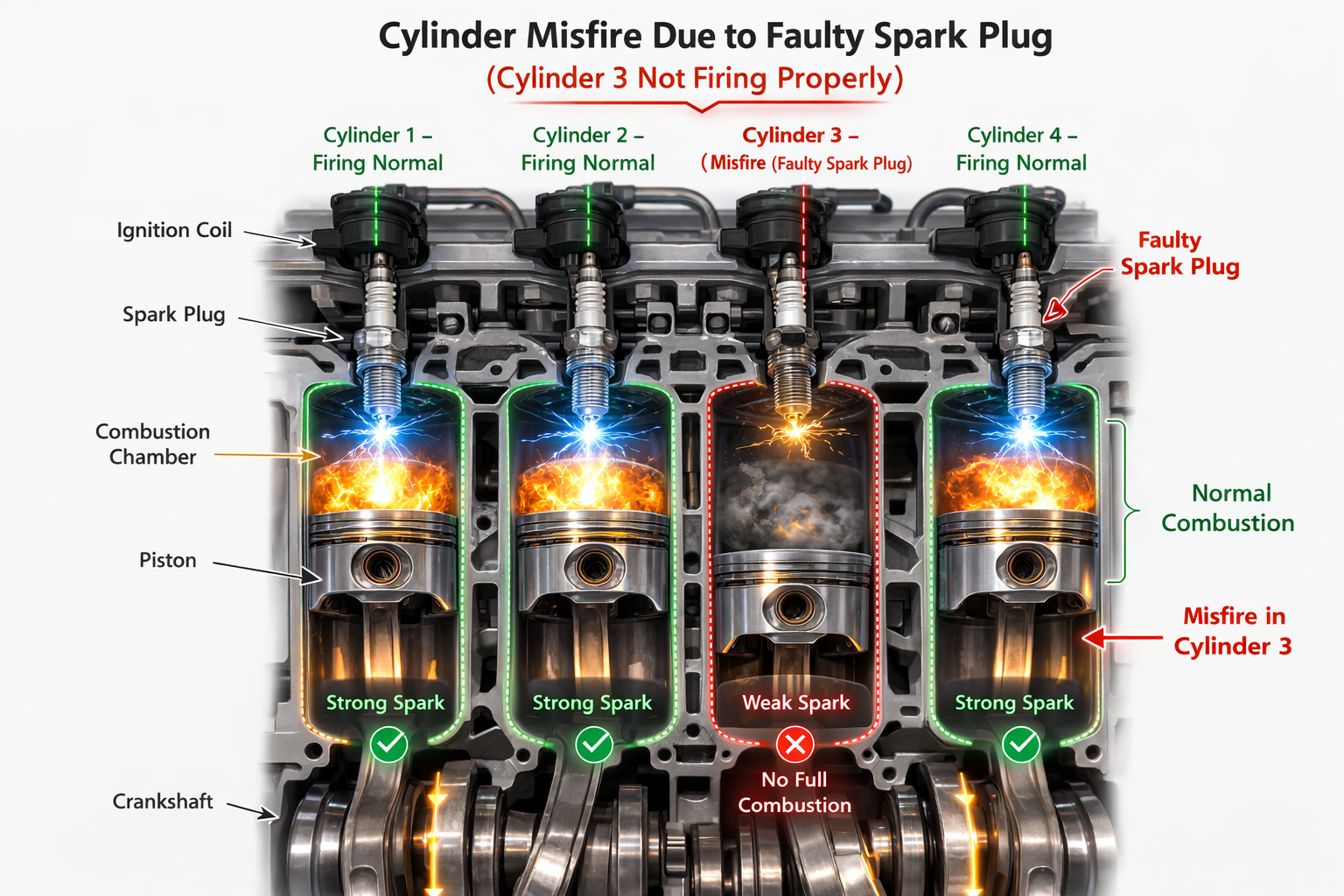
Most Common Causes of the P0302 Code
Because the code points directly to cylinder 2, the cause is usually related to something that affects that specific cylinder.
In many cases, the issue starts with the spark plug. Spark plugs wear out over time, and when they do, they may not produce a strong enough spark to ignite the air-fuel mixture. If the spark plug in cylinder 2 is worn, fouled, or contaminated, it can easily lead to a misfire.
Another common cause is the ignition coil. The coil is responsible for generating the high voltage needed to create the spark. If the coil serving cylinder 2 starts to fail, the spark may become weak or inconsistent. This often results in intermittent misfires that gradually get worse.
Fuel delivery is another area to consider. The fuel injector for cylinder 2 must deliver a precise amount of fuel at the right moment. If it becomes partially clogged or stops working properly, the cylinder may not receive enough fuel, leading to incomplete combustion.
Air leaks can also play a role. If there is a vacuum leak near cylinder 2, extra air may enter the engine without being measured. This disrupts the air-fuel mixture and can cause the cylinder to run too lean, making proper combustion difficult.
In some cases, the issue is mechanical. Cylinder 2 must be able to compress the air-fuel mixture properly before ignition. If there is a loss of compression—due to worn piston rings, leaking valves, or a head gasket issue—the mixture may not ignite as it should. When that happens, the ECU detects the imbalance and logs the P0302 code.
P0302 vs P0300 Misfire Code
Misfire codes follow a simple pattern, but the difference between them matters a lot when diagnosing a problem.
The P0302 code points directly to cylinder 2, which makes it more straightforward to investigate. You can focus your attention on the components that affect that specific cylinder.
The P0300 code, on the other hand, indicates misfires that occur randomly across multiple cylinders. That type of problem is usually caused by something that affects the entire engine, such as fuel pressure issues or air intake problems.
If you want to understand how random misfires differ and why they are often harder to diagnose, you can read our guide on the P0300 code — random engine misfire explained.
Is It Safe to Drive With a P0302 Code?
Whether you can continue driving depends on how severe the misfire is.
If the symptoms are mild—maybe just a slight rough idle and a solid check engine light—you can usually drive short distances carefully. That said, it’s still important to address the issue soon before it gets worse.
If the engine starts shaking more noticeably or feels weak under acceleration, it’s a sign that the misfire is becoming more serious. At that point, driving should be limited.
A flashing check engine light is the clearest warning that you should stop driving as soon as possible. Severe misfires can send unburned fuel into the exhaust system, where it can overheat the catalytic converter. This can lead to costly repairs that are far more expensive than fixing the original issue.
If you’re unsure how serious your situation is, this guide on check engine light meaning explains how to interpret warning signals correctly.
How Mechanics Diagnose a P0302 Code
Diagnosing a cylinder-specific misfire usually follows a logical process.
The first step is confirming the code using an OBD2 scanner. This helps verify that the problem is indeed related to cylinder 2 and not part of a broader issue.
From there, a technician will typically inspect the spark plug and ignition coil for cylinder 2. These are the most common causes and are relatively easy to check.
One practical method is to swap components between cylinders. For example, the coil from cylinder 2 can be swapped with the coil from another cylinder. If the misfire moves to a different cylinder, the faulty component has been identified.
If the ignition system checks out, attention shifts to the fuel injector. The injector may be tested or cleaned to ensure it is delivering fuel properly.
If needed, a compression test is performed to check the internal condition of the cylinder. This helps determine whether the issue is mechanical.
If you want to try some of these basic checks yourself, this guide on how to diagnose car problems at home explains how drivers can safely start the process before visiting a mechanic.
How to Fix the P0302 Code
The solution depends on what’s causing the misfire, but in many cases, the repair is relatively straightforward.
If the issue is a worn spark plug, replacing it is often enough to restore normal operation. This is one of the most common and least expensive fixes.
If the ignition coil is faulty, replacing it will usually solve the problem. Many vehicles use one coil per cylinder, so the repair is limited to the affected cylinder.
When the problem comes from the fuel injector, cleaning it may restore proper function. In more severe cases, the injector may need to be replaced.
If a vacuum leak is causing the issue, repairing the affected hose or gasket will correct the air-fuel mixture.
Mechanical problems, such as low compression, are less common but more complex to repair. These typically require more in-depth engine work.
How to Prevent Cylinder Misfires
While not every misfire can be avoided, good maintenance goes a long way in reducing the risk.
Replacing spark plugs at the recommended intervals ensures that the ignition system continues to perform properly. Using quality fuel helps keep injectors clean and functioning as intended.
Keeping the air intake system in good condition also helps maintain the correct air-fuel mixture, which is essential for proper combustion.
Regular maintenance may seem simple, but it’s one of the most effective ways to avoid problems like the P0302 code.
Frequently Asked Questions
What does P0302 code mean?
The P0302 code indicates that the engine has detected a misfire in cylinder 2.
Can bad spark plugs cause P0302?
Yes, a worn or fouled spark plug in cylinder 2 is one of the most common causes.
Can I drive with P0302?
Short trips may be possible if symptoms are mild, but the issue should be addressed quickly.
Is P0302 serious?
It can become serious if ignored, especially if it leads to catalytic converter damage.
What causes cylinder 2 misfire?
Common causes include spark plug issues, ignition coil failure, fuel injector problems, vacuum leaks, or low compression.
How do you fix P0302?
The fix depends on the cause but often involves replacing spark plugs, coils, or cleaning injectors.
Final Advice
The P0302 code is a clear signal that cylinder 2 is not operating the way it should. While the problem may start small, it rarely fixes itself and often becomes worse over time.
The good news is that most causes are straightforward to diagnose and repair when caught early. Paying attention to the symptoms and acting quickly can save you from more expensive repairs down the line.
If your check engine light has brought you here, consider it a helpful warning—not a disaster. With the right approach, this is a problem that can usually be resolved without major complications.