
The 2-Second Summary:
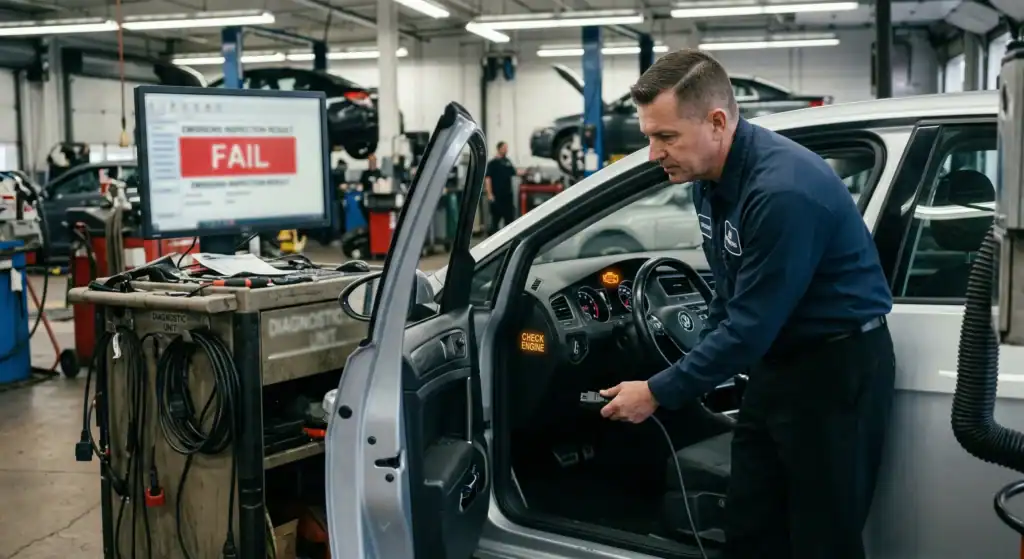
Under the strict 2026 Emissions Standards, if your check engine light is on—even for a minor issue like a loose gas cap—your vehicle will automatically fail the inspection. In almost all jurisdictions, a lit Malfunction Indicator Light (MIL) is a “hard fail” before the technician even hooks up their equipment.
The Direct Answer: Can You Pass emissions With a Solid CEL?
The short answer is a definitive No.
Whether you are in California, New York, or any state following the updated 2026 Regulatory Guidelines, an illuminated check engine light is an immediate disqualifier. It doesn’t matter if your car drives perfectly, achieves 40 MPG, or was “just serviced.” If the onboard computer (ECU) is reporting an active fault, the emissions station is legally required to fail the vehicle.
At CarLogicLab, we receive hundreds of queries from drivers hoping that a “small” sensor issue won’t count. Unfortunately, the sensor’s job is to monitor emissions; if the sensor is broken, the state considers your emissions “unverified,” which is treated the same as a “gross polluter” status.
🚨 2026 Regulatory Alert: The No-Tolerance Policy
In previous years, some states allowed vehicles to pass with one “Incomplete” monitor (often the EVAP monitor, as it is notoriously difficult to set).
As of 2026, many jurisdictions have moved to a “Zero Tolerance” model for vehicles manufactured after 2010. This means:
- Zero Active Codes: No stored P-codes allowed.
- Zero Pending Codes: Even if the light isn’t on yet, a “pending” code in the system will trigger a fail.
- All Monitors “Ready”: Every single internal self-test must be completed and marked as “Ready.”
The “Readiness Monitor” Secret: It’s Not Just About the Light
Most drivers believe that if they simply turn the light off, they will pass. This is the most common mistake in automotive DIY.
Your car’s ECU runs several continuous and non-continuous “Self-Tests” known as Readiness Monitors. These monitors check specific subsystems to ensure they are functioning within federal EPA limits. These include:
- Catalyst Monitor: Checks the efficiency of your catalytic converter.
- EVAP Monitor: Checks for fuel vapor leaks in the gas tank and lines.
- O2 Sensor Monitor: Checks the speed and voltage of your oxygen sensors.
- Heated O2 Monitor: Ensures the sensors reach operating temperature quickly.
- Misfire Monitor: Checks for engine timing and combustion issues.
When you have a check engine light, it means one of these monitors has detected a failure. If you clear the code, you aren’t “fixing” the monitor—you are resetting it to an “Incomplete” or “Not Ready” state.
The “Cleared Code” Trap: Why Manual Resets Fail
If you follow our guide on How to Reset a Check Engine Light Without a Scanner right before pulling into an inspection station, you will fail.
Here is why: When you disconnect the battery or clear codes, the ECU memory is wiped clean. When the state’s computer plugs into your OBD2 port, it asks: “Have the Catalyst, EVAP, and O2 monitors finished their tests?” If you just reset the light, the answer is “No.” The technician will hand you a “Not Ready” rejection slip. You won’t get a “Fail” sticker, but you will be sent away and told to drive 100+ miles before returning for a re-test—often requiring you to pay the inspection fee twice.
How to “Pre-Test” at Home (The Peace of Mind Hook)
The smartest way to handle emissions is to know you will pass before you ever leave your driveway. This is where the “Tool Gap” becomes a “Success Gap.”
Modern high-quality scanners, like the BlueDriver Bluetooth Professional Tool, feature a dedicated Emissions Readiness button.
Why a “Pre-Test” is Essential:
- Status Verification: It shows you a simple Green/Yellow/Red status for every monitor (EVAP, Catalyst, O2).
- Pending Code Detection: It identifies “Pending” codes that haven’t turned the light on yet but will still cause a failure.
- Confidence: You don’t have to guess if your “Drive Cycle” is complete. You check your phone, see all “Green Checks,” and head to the station knowing you’re compliant.
To find the right tool for this “Peace of Mind” check, visit our guide: Top 5 Car Diagnostic Scanners for 2026.
The CarLogicLab Emissions Preparation Checklist
If your light was recently on and you have performed a repair, follow this checklist to ensure your monitors are “Ready.”
1. Complete a Full “Drive Cycle” (50–100 Miles)
You cannot simply drive around the block. A drive cycle requires specific parameters:
- Start the car cold and let it idle for 3 minutes.
- Drive at a steady 55 mph for 15 minutes (using cruise control helps).
- Perform several stop-and-go cycles in city traffic.
- Allow the car to “cold soak” (sit overnight) after the drive.
2. The “Goldilocks” Gas Level (25% to 75%)
This is a professional secret. The EVAP Monitor—the most difficult one to set—will not run if your gas tank is full or near empty. To get this monitor to switch to “Ready,” keep your tank between 1/4 and 3/4 full.
3. Engine Temperature
Never pull into an emissions station with a cold engine. Ensure you have been driving for at least 20 minutes so the Catalyst and O2 Sensor monitors are operating at peak temperature.
Summary: The Pass/Fail Checklist
| Requirement | Status for PASS |
| Check Engine Light | OFF (Must not be lit) |
| Pending Codes | NONE (Clear system memory) |
| Catalyst Monitor | READY |
| EVAP Monitor | READY (Zero Tolerance in 2026) |
| O2 Sensor Monitor | READY |
| Misfire Monitor | READY |
When to Seek Professional Help
If you have addressed the 7 common causes of a check engine light but your Catalyst or EVAP monitors refuse to set to “Ready” after 200 miles of driving, you likely have a “soft failure.” This is a component that is working just well enough to keep the light off, but not well enough to pass the ECU’s strict internal self-test.
At this stage, stop the guesswork. Use a professional-grade scanner to look at “Live Data” or visit a certified technician.
Ready to take control of your car’s health? * Next Step: See our Top 5 Car Diagnostic Scanners for 2026 to find a tool that lets you pre-test your emissions status for free, forever.
- Deep Dive: Read our Check Engine Light On? 7 Causes, What It Means & What To Do to diagnose why that light appeared in the first place.