
🚨 IMMEDIATE ACTION REQUIRED: > If your check engine light is currently blinking, pull over to a safe location and turn off the engine immediately. A blinking light is the automotive equivalent of a 911 call. Continuing to drive, even for a few miles, can result in catastrophic engine failure and repair bills exceeding $5,000.
The “Stop Now” Warning: Solid vs. Blinking
At CarLogicLab, we treat a solid check engine light as a “yellow flag”—it’s a warning to schedule service soon. However, a blinking check engine light is a “red flag.”
A blinking light indicates an active engine misfire so severe that unburned fuel is being dumped directly into your exhaust system. This isn’t just a sensor glitch; it is a physical malfunction that is currently destroying your engine’s most expensive components in real-time. Every second the engine runs while that light flashes, you are moving closer to a total mechanical meltdown.
The $2,500 Melting Point: Your Catalytic Converter
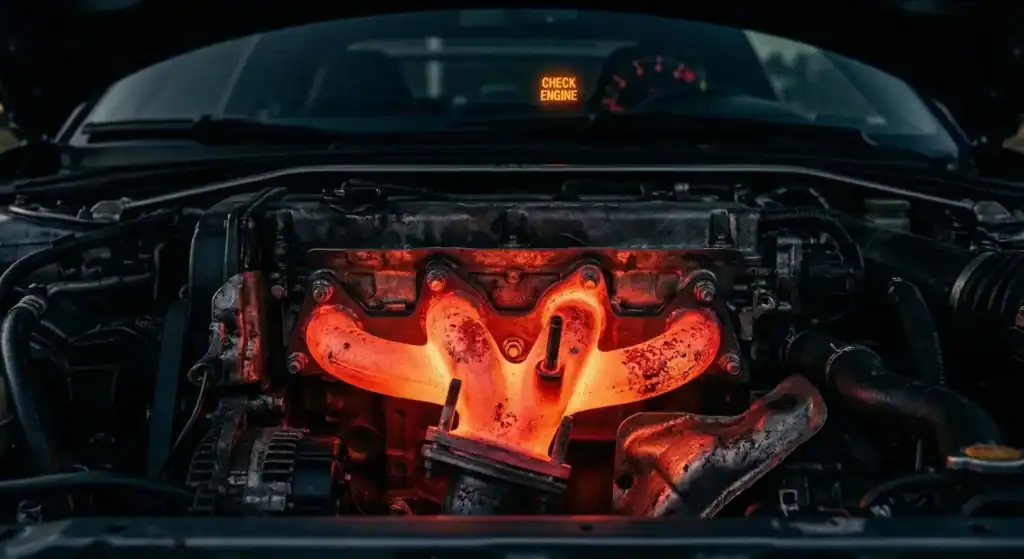
The most immediate victim of a blinking light is your catalytic converter. This component uses precious metals (platinum, palladium, and rhodium) to scrub harmful gases from your exhaust.
When an engine misfires, the spark plug fails to ignite the fuel in the cylinder. That raw, liquid gasoline is then pushed out of the cylinder and into the white-hot catalytic converter.
- The Ignition: The fuel ignites inside the converter rather than the engine.
- The Meltdown: Internal temperatures quickly skyrocket past 2,000°F.
- The Result: The ceramic honeycomb structure inside the converter melts and fuses together, completely choking your engine’s ability to “breathe.”
The Financial Math: Replacing an ignition coil (a common cause of a blink) costs roughly $100–$200. Replacing a melted catalytic converter on a modern SUV can easily top $2,500.
The Mechanical “Domino Effect”
Ignoring the blink doesn’t just ruin the exhaust; it starts a chain reaction of internal destruction known as the “Domino Effect.”
1. Cylinder Wall Wash
Gasoline is a solvent. When a cylinder misfires, the raw fuel washes away the thin film of lubricating oil on the cylinder walls. Without oil, the piston rings grind against the metal walls, leading to loss of compression and permanent engine scoring. This can turn a simple ignition fix into a full engine rebuild.
2. Oxygen Sensor Poisoning
The intense soot and half-burned fuel produced during a misfire coat your Oxygen (O2) sensors in a thick layer of carbon. This “poisons” the sensors, making them send incorrect data to the ECU, which further messes up the fuel-to-air ratio and worsens the damage.
3. Engine Hydrolock (The Extreme Case)
If the blinking light is caused by a stuck-open fuel injector, the cylinder can fill with liquid gasoline while the car is parked. Since liquids cannot be compressed, attempting to start the car can snap a connecting rod or crack the engine block—an instant “death sentence” for your vehicle.
Symptoms of Imminent Failure: The Red Flags
If your light is blinking, you will likely notice these terrifying symptoms:
- Heavy Shuddering: The car feels like it’s struggling to stay running, especially at stoplights.
- Dramatic Power Loss: The car loses power while accelerating as if it’s towing a massive weight.
- Raw Gas Smell: You smell unburned fuel coming through the vents or from the tailpipe.
- Backfiring: Loud “pops” from the exhaust as fuel ignites in the pipes.
Fix Now vs. Fix Later: The Cost Comparison
| Component | “Fix Now” Cost (DIY/Pro) | “Fix Later” Cost (Total Failure) |
| Spark Plugs | $50 – $150 | $2,500 (Catalytic Converter) |
| Ignition Coil | $100 – $250 | $4,000+ (Engine Internal Damage) |
| Fuel Injector | $200 – $400 | $5,000+ (Hydrolock/New Engine) |
| Gas Cap | $20 | $120 (Diagnostic Fee + Failed Smog) |
The “Diagnostic Race”: Why You Need a Scanner NOW
When the light blinks, you are in a race against time. You cannot afford to “wait and see” if the light goes away. However, driving to a mechanic just to find out what’s wrong can be the very trip that melts your converter.
The Solution: A Bluetooth OBD2 Scanner is your emergency “First Aid Kit.”
By plugging in a tool like the BlueDriver or a similar professional-grade dongle, you can pull the code in your driveway in seconds.
- P0300: Random/Multiple Cylinder Misfire.
- P0301 – P0308: Specific Cylinder Misfire (Tells you exactly which plug or coil died).
Knowing the code allows you to decide: “Can I fix this spark plug in my driveway today, or do I need a tow truck?” Being able to pull the code in your driveway tells you exactly which cylinder is failing before you drive to a shop and cause more damage.
CarLogicLab Survival Tip: If your light blinks, pull over, turn off the engine, and tow it. A $100 tow is significantly cheaper than a $5,000 engine replacement. Never “limp” a blinking car home.
Next Steps: Stopping the Damage
If you are lucky enough to have caught the blink early, here is your path to saving your vehicle:
- Identify the Culprit: Most blinking lights are caused by ignition failure. Check out our guide on Bad Spark Plug Symptoms to see if your plugs are the root cause.
- Get the Emergency Tool: Don’t guess when your engine is at stake. Check our Best OBD2 Scanners of 2026 to find a scanner that provides instant, life-saving data for your car.
- Consult the Hub: For a full list of what might be triggering your dashboard, return to our Check Engine Light On? 7 Causes, What It Means & What To Do.
The bottom line: The blinking light is a final warning. Respect the blink, or prepare for the bill.