
Introduction
You turn the key, your engine fires up… and then it shuts off almost immediately. If your car starts then dies, it can feel frustrating—and honestly, a little worrying. The good news? In many cases, this problem is more common (and often more manageable) than it seems.
Whether your car starts then dies immediately or your car starts then dies after a few seconds, the issue usually points to something interrupting fuel, air, or electrical flow. Think of it like your car taking a breath but not being able to keep breathing.
In this guide, I’ll walk you through what’s really going on, how to narrow down the cause, and what you can safely check yourself—without needing to be a mechanic.
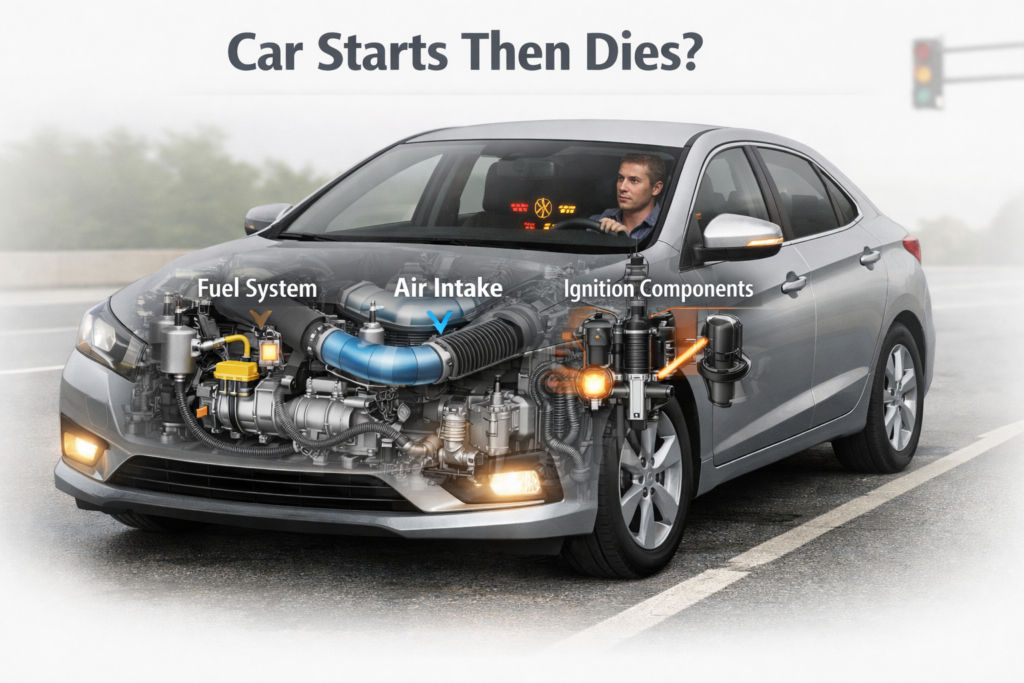
What It Means When Your Car Starts Then Dies
When your car starts and then stalls, it usually means one thing: the engine can ignite, but it can’t sustain itself.
For an engine to keep running, it needs three essentials working together:
- Fuel
- Air
- Spark (ignition)
If any one of these is interrupted—even briefly—the engine shuts down.
So when your car starts then stalls, it’s not completely broken. It’s actually giving you a clue: “I can start, but something’s stopping me from staying on.”
Quick Diagnosis: What Your Symptoms Are Telling You
Before jumping into repairs, it helps to pay attention to how the problem happens. Small details can point you in the right direction.
If your car starts then dies immediately, within 1–2 seconds:
- Could be a security/immobilizer issue
- Possible fuel delivery interruption
- Idle air control problems
If your car starts then dies after a few seconds:
- Fuel system may be weak or inconsistent
- Dirty throttle body or airflow issue
- Sensor-related problems
If the car only stays running when you press the gas:
- Likely an idle control or airflow issue
If this happens along with a check engine light, that’s actually helpful—it means your car has stored clues you can read.
And if you’ve noticed things like car shaking while driving or loss of power while driving, those can be related symptoms pointing to fuel or ignition problems. Once you identify which situation matches your car, the next step becomes much easier — you’re no longer guessing, you’re narrowing it down.
7 Common Causes of “Car Starts Then Dies”
Let’s go through the most likely reasons—just like I would in a shop when diagnosing this issue.
1. Fuel Delivery Problems
If your engine isn’t getting enough fuel, it simply won’t stay running.
This could be due to:
- A weak fuel pump
- A clogged fuel filter
- Dirty fuel injectors
When you first start the car, there’s often just enough fuel pressure to ignite. But once that initial push fades, the engine stalls.
If your car has also shown signs of hesitation or loss of power while driving, you may also want to understand why a car loses power while accelerating, as both issues often come from the same system.
2. Faulty Idle Air Control Valve (IAC)
Your engine needs a steady amount of air when idling. That’s where the idle air control valve comes in.
If it’s dirty or failing:
- The engine may start fine
- But it won’t maintain idle speed
- Result: it stalls almost immediately
This is especially common in older vehicles.
3. Dirty or Faulty Throttle Body
The throttle body controls how much air enters the engine.
Over time, carbon buildup can restrict airflow. When that happens:
- The engine struggles to “breathe” at idle
- It may start, then stall
A dirty throttle body is one of the most overlooked causes—and one of the easier fixes.
4. Mass Air Flow (MAF) Sensor Issues
The MAF sensor measures how much air is entering your engine and helps adjust fuel accordingly.
If it sends incorrect data:
- The engine may get too much or too little fuel
- This imbalance can cause stalling
A bad MAF sensor often causes rough running, poor acceleration, or even car shaking while driving.
5. Anti-Theft or Immobilizer System Problems
Modern cars have security systems that prevent theft.
If the system doesn’t recognize your key:
- The car may start briefly
- Then shut off immediately
This often looks like a mechanical issue, but it’s actually electronic.
6. Vacuum Leaks
Your engine relies on a sealed system to manage air pressure.
If there’s a vacuum leak:
- Too much air enters the system
- The air-fuel mixture becomes unbalanced
- The engine stalls
You might also notice rough idling or a hissing sound.
7. Ignition System Problems
If the spark isn’t consistent, your engine won’t keep running.
This could involve:
- Worn spark plugs
- Faulty ignition coils
- Electrical issues
Sometimes the engine starts on residual spark, then dies once it can’t maintain ignition.
Step-by-Step: How to Diagnose the Problem Yourself
Before replacing anything, it’s always best to observe first. Here’s how I’d guide someone through this at home.
Start by turning the key and watching what happens closely.
Does the engine die instantly, or after a few seconds?
Does pressing the gas keep it alive?
Are there warning lights?
Next, listen carefully. A weak fuel pump might sound quieter than usual. A vacuum leak may produce a faint hissing noise.
Check simple things:
- Is your fuel tank actually full? (It happens more often than you think.)
- Is your air filter clogged?
- Are battery connections tight?
Then, try starting the car while gently pressing the accelerator.
If the engine stays running only when you press the gas, that strongly points to an airflow or idle issue.
At this point, the easiest way to confirm what’s going on is to scan the car’s computer system.
This is exactly where a simple OBD2 scanner becomes useful. Instead of guessing, you can quickly see if the issue is related to fuel, sensors, or ignition. Even basic models are enough to give you a clear direction.
Tools That Can Help Diagnose the Issue
Modern cars are surprisingly good at telling you what’s wrong—you just need a way to listen.
An OBD2 scanner plugs into your car and reads diagnostic trouble codes. If your check engine light is on, this tool can give you a clear starting point.
Even if the light isn’t on, some scanners can still show live data like:
- Fuel trim levels
- Airflow readings
- Sensor performance
If you’re trying to diagnose car problems at home, this is one of the most useful tools you can have.
You don’t need anything fancy—just something reliable enough to read codes and basic data.
When the Problem Becomes Serious
Sometimes, a car that starts then dies is just an inconvenience. Other times, it’s a warning sign.
You should take the issue seriously if:
- The car stalls while driving
- It becomes harder to restart
- You notice strong fuel smells
- The engine runs rough or shakes
A stall in traffic isn’t just frustrating—it can be dangerous.
If your car shuts off while moving or becomes unpredictable, it’s best to stop driving and get it checked professionally.
Final Thoughts
If your car starts then dies, don’t panic. In many cases, the issue comes down to something manageable—like airflow, fuel delivery, or a sensor problem.
The key is to stay calm, observe the symptoms, and take a step-by-step approach.
Start with the basics. Pay attention to how your car behaves. Use simple tools when needed. And remember—you don’t have to guess your way through it.
With a little patience, you can often narrow down the cause before spending money on repairs.
Frequently Asked Questions
1. Why does my car start then die immediately?
This usually points to a fuel delivery issue, an idle control problem, or a security system fault. The engine can start but can’t sustain itself.
2. Can a bad battery cause a car to start then stall?
It’s possible, but less common. A weak battery usually prevents starting altogether. However, poor electrical connections can sometimes cause stalling.
3. Is it safe to drive if my car starts then dies?
No. If the car stalls unpredictably, especially while driving, it can be dangerous. It’s best to diagnose the issue before driving further.
4. Could low fuel cause this problem?
Yes. If fuel levels are extremely low or the fuel pump is struggling, the engine may start but fail to keep running.
5. How do I know if it’s a fuel pump issue?
Look for signs like difficulty starting, loss of power, or a whining noise from the fuel tank area.
6. Do I need a mechanic to fix this problem?
Not always. Some causes—like a dirty throttle body or loose connections—can be handled at home. But more complex issues may require professional diagnosis.
7. Will an OBD2 scanner help with this issue?
Absolutely. It can provide error codes and live data that make diagnosing the problem much easier and more accurate.