
It’s easy to ignore the small, hardworking parts of your engine until something goes wrong. Spark plugs are a perfect example. These tiny components are absolutely critical for engine performance, creating the spark that brings your engine to life. When they start to fail, they can cause a surprising number of problems, from annoying stutters to serious performance issues.
Ignoring the warning signs of a bad spark plug can lead to bigger, more expensive headaches down the road, including poor fuel economy, failed emissions tests, and even catalytic converter damage. But here’s the good news: your car will almost always tell you when your spark plugs need attention. You just have to know what to listen for.
As a mechanic with years of experience under the hood, I’m here to walk you through the most common bad spark plug symptoms. This guide will help you diagnose potential spark plug problems early, understand what’s happening in your engine, and decide on the right next steps.
What Do Spark Plugs Do?
Think of a spark plug as the match that lights the fire in your engine. Its only job is to create a tiny, precise bolt of lightning—a spark—across a small gap at its tip. This spark ignites the mixture of air and fuel that has been compressed inside your engine’s cylinders.
This controlled explosion is what pushes the piston down, turns the crankshaft, and ultimately, moves your car forward. This happens thousands of times per minute. For your engine to run smoothly and efficiently, that spark needs to be strong, consistent, and perfectly timed.
When spark plugs get old and worn, that spark becomes weak or inconsistent. This means the air-fuel mixture doesn’t burn completely, leading to a loss of power, wasted fuel, and increased emissions. Understanding this simple function is the first step to diagnosing failing spark plug signs.
7 Bad Spark Plug Symptoms You Should Never Ignore
If you notice any of these warning signs, your spark plugs should be at the top of your inspection list. Here are the seven most common symptoms of bad spark plugs.
1. Engine Misfires
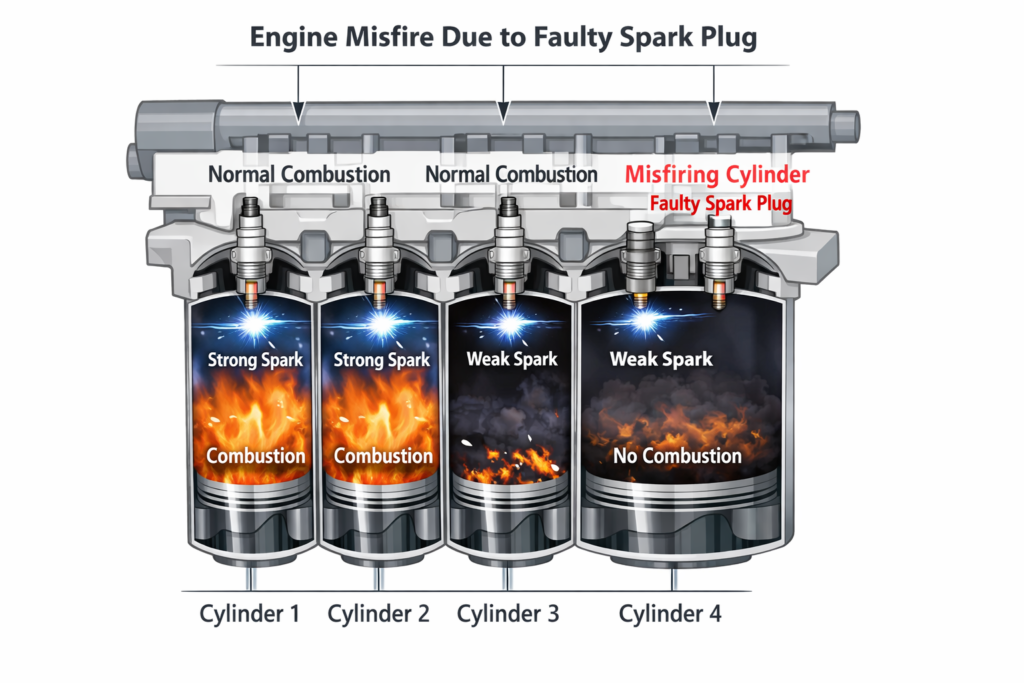
- What You’ll Notice: An engine misfire feels like a stumble, shake, or hesitation while you’re driving. The engine might momentarily lose power, causing the car to jerk or shudder. It can happen when you’re accelerating, cruising at a steady speed, or even idling. These are classic engine misfire symptoms.
- Why It Happens: A worn-out or fouled spark plug fails to ignite the air-fuel mixture in a cylinder at the right moment. This “missed” combustion cycle throws the engine’s rhythm off balance, causing the noticeable jolt.
- Is It Safe to Drive? Driving with an occasional, light misfire might get you to the shop, but it’s not recommended for long. A constant misfire can dump unburned fuel into the exhaust system, potentially overheating and destroying your expensive catalytic converter.
2. Rough Idle
- What You’ll Notice: When your car is stopped at a traffic light or parked with the engine on, you might feel a rough, shaky vibration. The engine sound might be unsteady instead of a smooth, consistent hum. The RPM needle on your tachometer may also jump around erratically.
- Why It Happens: At idle, your engine is running at its lowest speed, making it very sensitive to ignition problems. A weak spark from a failing plug can cause incomplete combustion, and these inconsistent power pulses create vibrations that you feel in the cabin.
- Is It Safe to Drive? A rough idle is more of an annoyance than a critical safety issue, but it’s a clear sign your engine isn’t happy. It’s one of the earliest worn spark plug symptoms and should be addressed to prevent further issues.
3. Difficulty Starting the Car
- What You’ll Notice: You turn the key, and the engine cranks over and over but struggles to start. It might eventually catch, or it might not start at all. This problem is often more noticeable on cold mornings.
- Why It Happens: A car’s engine needs a strong, reliable spark to fire up, especially when it’s cold. Weak or fouled spark plugs can’t produce a hot enough spark to ignite the cold, dense air-fuel mixture, leading to a no-start or hard-start condition.
- Is It Safe to Drive? If your car won’t start, you’re not going anywhere. If it’s just hard to start, you can likely drive it, but you risk getting stranded the next time you try to start it.
4. Poor Fuel Economy
- What You’ll Notice: You find yourself visiting the gas station more often than you used to. Your car’s “miles per gallon” display shows a lower number, or you’re simply getting fewer miles out of a full tank.
- Why It Happens: When spark plugs aren’t firing efficiently, a portion of the fuel in the combustion chamber doesn’t get burned. Your engine has to work harder—and use more fuel—to produce the same amount of power. Your car’s computer may try to compensate for the incomplete combustion by injecting even more fuel, making the problem worse.
- Is It Safe to Drive? Yes, but it’s costing you money with every mile. Think of it as burning cash. Addressing the issue will not only make your car run better but also save you money in the long run.
5. Slow or Sluggish Acceleration
- What You’ll Notice: When you press the gas pedal, your car feels lazy or unresponsive. It doesn’t have the “get-up-and-go” it once did. This is a common symptom when your car loses power when accelerating.
- Why It Happens: Acceleration demands a strong and rapid series of sparks to burn the extra fuel being sent to the engine. Worn spark plugs can’t keep up with this demand. The weak spark results in a sluggish response, making your car feel underpowered and slow.
- Is It Safe to Drive? Generally, yes, but it can be a safety hazard if you need to merge quickly onto a highway or pull out into fast-moving traffic. It indicates your engine is not producing the power it was designed for.
6. Engine Knocking or Hesitation
- What You’ll Notice: You might hear a pinging or knocking sound from the engine, especially when you’re climbing a hill or accelerating. The engine may also hesitate or stumble briefly before picking up speed.
- Why It Happens: A knocking sound can occur if a spark plug is damaged or has excessive carbon buildup. This can create a “hot spot” that pre-ignites the fuel mixture before the plug even fires, a dangerous condition called detonation. Hesitation is also a sign of a weak or delayed spark that disrupts smooth power delivery.
- Is It Safe to Drive? Engine knocking should be taken seriously. Persistent knocking can cause severe internal engine damage. If you hear this sound, you should get your vehicle checked by a mechanic as soon as possible.
7. Check Engine Light Is On
- What You’ll Notice: The dreaded yellow or orange engine icon illuminates on your dashboard. This is your car’s primary way of telling you that its computer has detected a problem. A flashing check engine light is even more serious—it signals a severe misfire.
- Why It Happens: The engine control unit (ECU) monitors the entire ignition system. When it detects an engine misfire or another issue related to poor combustion, it triggers the check engine light meaning something is wrong. Common trouble codes associated with spark plugs include P0300 (Random Misfire) and P0301-P0308 (Cylinder-Specific Misfire).
- Is It Safe to Drive? If the light is steady, you can usually drive to a mechanic. If the light is flashing, pull over as soon as it is safe to do so and turn off the engine. A flashing light indicates a severe misfire that can quickly destroy your catalytic converter, leading to a very expensive repair.
What Causes Spark Plugs to Fail?
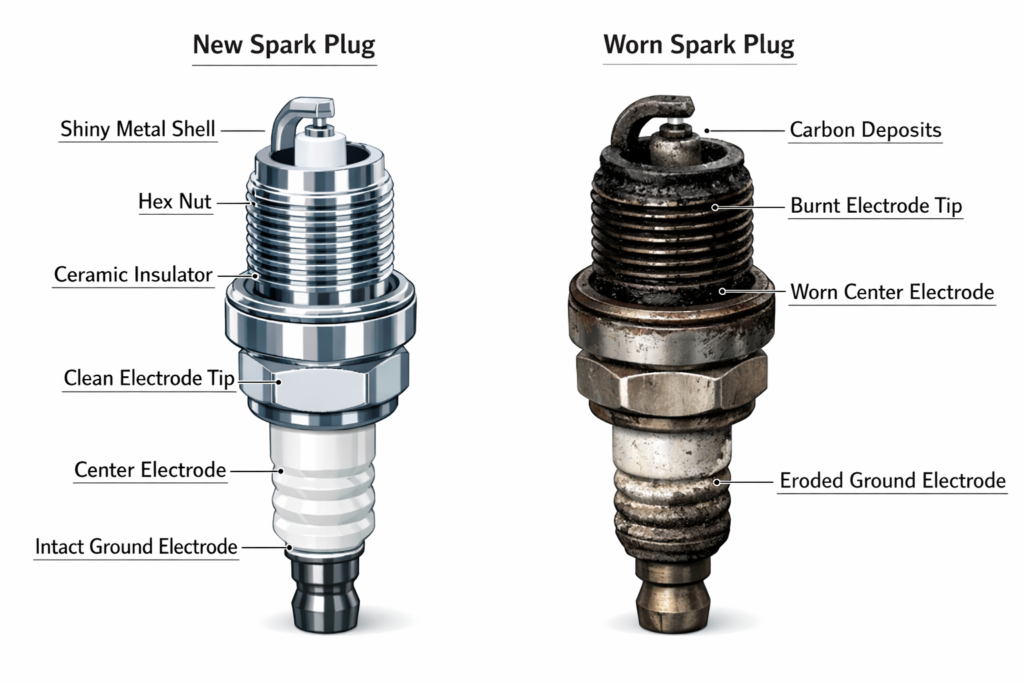
Spark plugs don’t last forever. Several factors can lead to their eventual failure:
- Normal Wear: Over tens of thousands of miles, the high voltage and intense heat slowly erode the spark plug’s electrodes. The gap between them widens, making it harder for a spark to jump across.
- Carbon Buildup: If the fuel mixture is too rich or the car is only driven on short trips, black, sooty carbon can build up on the plug’s tip. This carbon fouling can block the spark, leading to misfires.
- Oil Contamination: If internal engine gaskets or seals are leaking, oil can seep into the combustion chamber and foul the spark plugs. Oily plugs are a sign of a deeper engine problem that needs to be addressed.
- Overheating: An engine that overheats can cause the spark plug’s ceramic insulator to crack or the electrodes to melt, destroying the plug. This is often a symptom of other engine cooling problems.
- Incorrect Spark Plug Type: Every engine is designed for a specific type of spark plug with a specific heat range. Installing the wrong plugs can lead to poor performance, fouling, or even engine damage.
Can You Drive With Bad Spark Plugs?
This is a common question, and the answer depends on the severity of the symptoms.
- When It’s Relatively Safe: If you’re only experiencing a slightly rough idle or a minor decrease in fuel economy, you can likely drive the car for a short time. However, you should plan to get it inspected soon.
- When Damage Can Occur: Continuing to drive with consistent engine misfire symptoms is risky. As mentioned, it can cause unburned fuel to flood and destroy your catalytic converter—a repair that can cost over a thousand dollars. Ignoring severe symptoms like engine knocking can lead to catastrophic internal engine damage.
Safety Guidance: If your check engine light is flashing, do not drive the car. Pull over, turn it off, and call for a tow. It’s the safest and, in the long run, cheapest option.
How Mechanics Diagnose Spark Plug Problems
When you bring your car to the shop with these symptoms, a good mechanic will follow a logical diagnostic process. This helps confirm that spark plugs are the issue before replacing parts unnecessarily.
- Read Engine Codes: The first step is always to connect an OBD2 scanner to the car’s diagnostic port. This tool reads the trouble codes stored in the ECU, which often point directly to the misfiring cylinder.
- Inspect the Plugs: The mechanic will remove the spark plugs for a visual inspection. The condition of the plug tip tells a story—is it covered in black soot, oily residue, or white deposits? Is the electrode worn down? This helps diagnose the root cause.
- Check Ignition Coils: Each spark plug is connected to an ignition coil, which transforms the car’s 12-volt power into the high voltage needed for a spark. A faulty coil can mimic bad spark plug symptoms, so mechanics will often test the coils as well.
- Test Combustion Quality: Advanced diagnostics can analyze the combustion quality in each cylinder to confirm that the problem is ignition-related and not caused by a fuel injector or mechanical issue.
This is a key part of how to diagnose car problems at home—start with the data from an OBD2 scanner before you start turning wrenches.
How Often Should Spark Plugs Be Replaced?

Replacement intervals have gotten much longer thanks to modern technology, but they still vary widely depending on the type of plug your vehicle uses.
- Copper Plugs: These are the most basic and have the shortest lifespan, typically needing replacement every 20,000 to 40,000 miles.
- Platinum Plugs: Single and double platinum plugs offer a longer life, usually in the range of 60,000 to 100,000 miles.
- Iridium Plugs: These are the longest-lasting and are standard in most new cars. They can often last from 100,000 to 120,000 miles or even longer.
Always check your vehicle’s owner’s manual for the manufacturer’s recommended service interval. This is the definitive guide on when to replace spark plugs.
How Much Does It Cost to Replace Spark Plugs?
The cost can vary significantly based on your vehicle and whether you do the work yourself.
- DIY Replacement: If you’re comfortable working on your car, you can save a lot of money. A set of four spark plugs typically costs between $20 and $100. You’ll also need a basic socket set with a special spark plug socket.
- Mechanic Service: Having a professional do the job will add labor costs. For a typical 4-cylinder engine, you can expect to pay between $150 and $400. For more complex V6 or V8 engines, where the rear plugs might be difficult to access, the cost can be higher, sometimes reaching $500 to $800 or more.
How to Check Spark Plugs at Home (Beginner Guide)
If you have some basic tools and want to investigate yourself, here’s a simplified guide. Safety first: only do this on a cold engine.
- Locate the Spark Plugs: On most 4-cylinder engines, the plugs are in a line on top of the engine, under individual plastic covers called ignition coils or under a single plastic engine cover.
- Use an OBD2 Scanner: Before you start, plug in an OBD2 scanner. These are affordable and easy to use. The scanner will tell you if you have any misfire codes (like P0301 for cylinder 1) which will point you to the problem cylinder.
- Remove the Ignition Coil: Disconnect the electrical connector from the coil and unbolt it (usually one small bolt). Gently pull the coil straight up and out.
- Remove the Spark Plug: Use a socket wrench with a long extension and a spark plug socket to reach down into the hole. Turn counter-clockwise to loosen and remove the plug.
- Inspect the Plug: Look at the tip of the plug. It should be a light tan or grayish color. If it’s black and sooty, white and blistered, or wet with oil, you’ve found a problem.
Frequently Asked Questions
- What are the first symptoms of bad spark plugs?
The earliest signs are often a slightly rough idle and a small, noticeable drop in your car’s fuel economy. You might not even get a check engine light at this stage. - Can bad spark plugs cause a check engine light?
Absolutely. A failing spark plug is one of the most common reasons for the check engine light to come on. Misfires are detected by the engine’s computer, which triggers the light. - Will new spark plugs improve fuel economy?
Yes, if your old plugs were worn or fouled. By restoring efficient combustion, new spark plugs ensure that every drop of fuel is being used for power, which can lead to a measurable improvement in MPG. - Can bad spark plugs damage the engine?
Yes. While rare, ignoring severe symptoms like engine knocking (detonation) can lead to piston or cylinder wall damage. More commonly, a chronic misfire will destroy the catalytic converter. - How long do spark plugs last?
It depends on the type. Basic copper plugs can last 20,000 miles, while modern iridium plugs can last over 100,000 miles. Always check your owner’s manual for your car’s specific schedule. - Can I drive with a misfiring engine?
It is not recommended. If the check engine light is flashing, you must pull over immediately. If it’s a minor, intermittent misfire, you might be able to drive cautiously to a repair shop, but you risk damaging other expensive components.
Final Advice
Your spark plugs are small but mighty. Paying attention to these seven warning signs can save you from the stress of a breakdown and the high cost of related repairs. If your car is showing bad spark plug symptoms, don’t panic. The problem is usually straightforward to diagnose and fix.
Use this guide to understand what your car is telling you. A little bit of knowledge goes a long way in maintaining your vehicle’s health and your peace of mind on the road.