
When your car loses power while driving, it can feel unsettling — especially if it happens suddenly in traffic or while overtaking. One moment everything feels normal, and the next, the car struggles to accelerate, feels weak, or simply doesn’t respond the way it should.
The good news is this: in most cases, a loss of power while driving is your car’s way of warning you early. It’s rarely random. There’s usually a clear reason behind it — and if you understand the symptoms, you can often narrow it down quickly.
Let’s walk through this together, step by step, like a mechanic would explain it to you in the garage.
Table of Contents
What It Means When a Car Loses Power While Driving
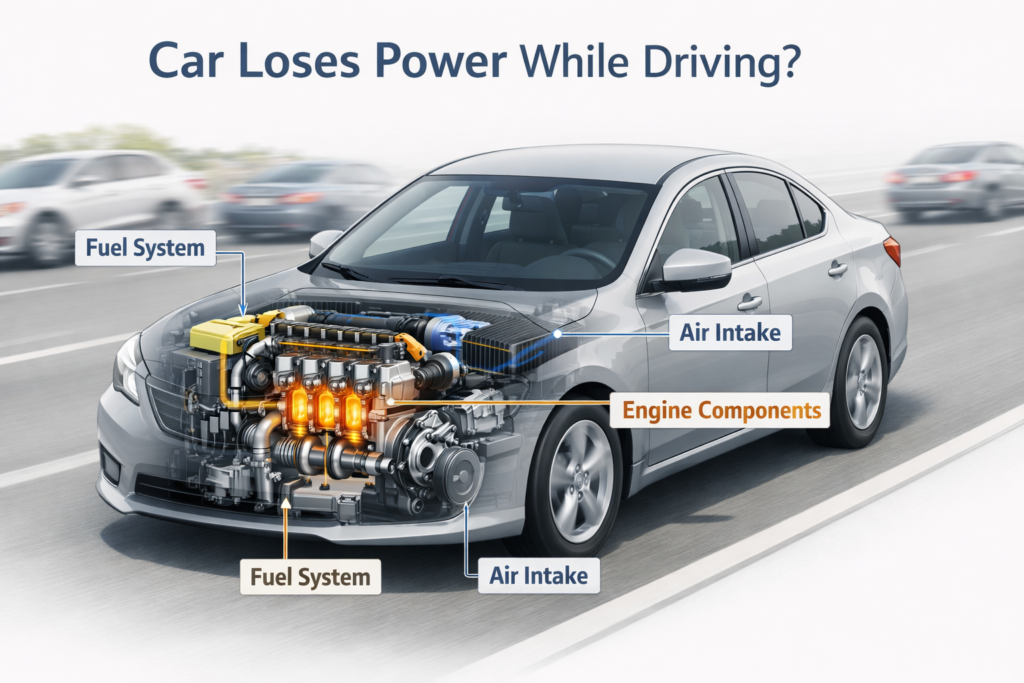
For your engine to run properly, it needs three main things working together:
- The right amount of fuel
- Clean air intake
- A strong spark to ignite the mixture
On top of that, modern cars rely on sensors and a computer (ECU) to manage everything precisely.
So when your engine loses power while driving, it usually means one of these things is off:
- Not enough fuel is reaching the engine
- Airflow is restricted
- The ignition system isn’t working properly
- The engine computer is limiting power to protect itself
Sometimes, it’s not even the engine — the transmission or exhaust system can also cause the car to feel weak.
Quick Diagnosis — What Your Symptoms Mean
Before jumping into parts and repairs, it helps to pay attention to how the power loss happens. That alone can tell you a lot.
Car loses power when accelerating
If your car feels fine at low speed but struggles when you press the gas, it often points to fuel delivery issues, clogged air intake, or ignition problems.
Car loses power uphill
Driving uphill puts more load on the engine. If the car feels weak only then, it usually means the engine isn’t producing enough power — often due to fuel, airflow, or compression issues.
Car loses power at high speed
If power drops at higher speeds, think about airflow restrictions or exhaust blockage. The engine simply can’t “breathe” properly.
Car loses power with a warning light
If you notice the check engine light coming on, the car may have entered a safety mode (often called limp mode) to prevent damage.
Car feels weak and rough
If the car also feels unstable, you might want to look into issues like car shaking while driving, which can be related to misfires or engine imbalance.
7 Common Causes of Power Loss While Driving
Let’s go through the most common reasons, explained simply and practically.
1. Fuel Delivery Problems
Your engine depends heavily on a steady supply of fuel. If that flow is interrupted, power drops immediately.
Common causes include:
- Weak fuel pump
- Clogged fuel filter
- Dirty or failing fuel injectors
When this happens, your car may hesitate, especially when accelerating. It can feel like the engine is “starving.”
If the issue gets worse, the car might even behave like a car starts then dies, especially when fuel pressure drops too low.
2. Air Intake Restrictions
Your engine needs clean air just as much as fuel.
If the air filter is clogged or the intake system is blocked, the engine won’t get enough oxygen to burn fuel properly. That leads to:
- Sluggish acceleration
- Reduced engine performance
- Poor fuel economy
This is one of the simplest issues to check — and one of the most overlooked.
3. Faulty Sensors or Limp Mode
Modern cars rely on sensors like:
- Mass Air Flow (MAF) sensor
- Throttle position sensor
- Oxygen sensors
If one of these sends incorrect data, the ECU may limit engine power to protect the system.
This is what mechanics call “limp mode.”
In this case, the car may:
- Refuse to accelerate properly
- Stay stuck at low speed
- Feel like it’s holding back
This is often accompanied by the check engine light.
4. Ignition System Problems
The ignition system is responsible for igniting the fuel-air mixture.
If components like spark plugs or ignition coils fail, the engine won’t burn fuel efficiently.
You may notice:
- Engine hesitation
- Rough driving
- Loss of power when accelerating
In more serious cases, this can lead to misfires — which not only reduce power but can also damage other components over time.
5. Exhaust Restriction (Very Common and Often Missed)
This is one of the most important causes — and many drivers don’t think about it.
Your engine needs to push exhaust gases out efficiently. If something blocks that flow, the engine can’t operate properly.
The most common culprit is a clogged catalytic converter.
When this happens:
- The engine struggles at higher speeds
- The car feels choked or restricted
- Acceleration becomes very slow
It’s like trying to breathe through a blocked pipe — the engine simply can’t release pressure.
6. Transmission Issues
Sometimes, the engine is working fine — but the power isn’t reaching the wheels properly.
Transmission problems can cause:
- Delayed acceleration
- Slipping gears
- High RPM but low speed
This often feels like the engine is revving, but the car isn’t responding.
It’s a different kind of power loss — but just as important to consider.
7. Overheating or Engine Protection Mode
If your engine temperature rises too much, the car may reduce power automatically to prevent damage.
This protection mode can make the car feel weak and unresponsive.
Signs include:
- Temperature gauge rising
- Reduced performance
- Cooling fan running constantly
In this case, the power loss is intentional — the car is trying to save itself.
Step-by-Step Diagnosis (What You Can Do First)
Now let’s make this practical.
If your car loses power while driving, here’s how to approach it calmly and logically.
1. Observe the symptoms carefully
Ask yourself:
- Does it happen when accelerating?
- Only uphill?
- At high speed?
- All the time?
These details are extremely helpful.
2. Check your dashboard
Look for Dashboard warning lights, especially the check engine light.
Even if the car feels okay sometimes, a warning light is a clear signal something isn’t right.
3. Test the car’s behavior
Try simple tests:
- Accelerate gently vs aggressively
- Drive at steady speed
- Let the car idle
Notice when the power loss appears.
4. Perform basic checks
Even without tools, you can check:
- Air filter condition
- Fuel level (yes, it matters more than you think)
- Obvious leaks or unusual smells
These simple checks can sometimes reveal the issue immediately.
5. Think about recent changes
Ask yourself:
- Did the problem start suddenly?
- After refueling?
- After maintenance?
This can point you in the right direction quickly.
6. Start learning to diagnose car problems at home
Understanding these basics puts you in control. You don’t need to be a mechanic — just observant and methodical.
Tools That Can Help Diagnose the Issue
At this point, the easiest way to confirm what’s happening is to use an OBD2 scanner.
This small device connects to your car and reads error codes from the system.
Here’s why it’s helpful:
- It tells you which system is failing
- It saves time guessing
- It helps you avoid unnecessary repairs
For example, instead of wondering if it’s fuel, air, or ignition — the scanner can point you directly to a faulty sensor or misfire.
It’s one of the simplest ways to diagnose car problems at home without expensive tools.
When the Problem Becomes Serious
Not all power loss situations are equal.
You should stop driving or seek help immediately if:
- The car struggles to maintain speed in traffic
- Power drops suddenly on the highway
- You smell burning or strong fuel odors
- The engine runs very rough
Power loss can become dangerous if it affects your ability to control the car safely.
Final Thoughts
If your car loses power while driving, don’t panic.
In most cases, it’s a manageable issue — and often something that gives warning signs before becoming serious.
The key is to:
- Pay attention to symptoms
- Understand what your car is telling you
- Take simple steps to narrow down the cause
Think of it this way: your car isn’t failing randomly — it’s communicating. Once you learn to read those signs, diagnosing problems becomes much easier.
FAQ
Is it safe to drive if my car loses power while driving?
It depends on the severity. Mild power loss may be manageable short-term, but sudden or severe loss can be dangerous, especially in traffic.
What causes a car to lose power when accelerating?
The most common causes are fuel delivery issues, clogged air intake, or ignition problems.
Can a bad catalytic converter cause power loss?
Yes, absolutely. A clogged catalytic converter can restrict exhaust flow and significantly reduce engine performance.
Will an OBD2 scanner tell me exactly what’s wrong?
It won’t always give the full answer, but it will point you in the right direction by identifying the system involved.
Why does my car feel weak when driving uphill?
Because the engine is under more load. Any weakness in fuel, air, or ignition systems becomes more noticeable under stress.
If you want, I can now turn this into a perfect prompt template so you can generate multiple articles in this cluster consistently (very useful for scaling Carlogiclab).