
An engine misfire is one of the most common—and most misunderstood—car problems a driver can experience. That sudden shake, stutter, or loss of power can be alarming, but it’s your car’s way of telling you something needs attention. Ignoring an engine misfire can lead to a domino effect of problems, including poor fuel economy, increased emissions, and even catastrophic damage to expensive components like your catalytic converter.
As a seasoned mechanic, I’m here to demystify the engine misfire. This guide will walk you through what’s happening under the hood, how to recognize the engine misfire symptoms early, and what steps you can take to diagnose and fix the issue. Understanding what causes an engine misfire is the first step toward a solution.
In many cases, the root cause of an engine misfire is related to bad spark plug symptoms that prevent proper ignition.
What Is an Engine Misfire?
Think of your engine as a team of rowers in a boat. For the boat to move smoothly, each rower needs to pull their oar in perfect sync. In your engine, these “rowers” are the cylinders, and the “pull” is the controlled explosion of a finely-tuned mixture of air and fuel. This process, called combustion, happens thousands of times per minute to generate power.
A misfire occurs when one or more of these cylinders fails to fire correctly. This means the air-fuel mixture in that cylinder misfire doesn’t ignite at all, or the combustion is weak and incomplete. This missed or weak power stroke throws the engine’s rhythm and balance off, causing the telltale shaking and stuttering you feel from the driver’s seat. It’s an imbalance of power that your car’s sensors can easily detect.
7 Engine Misfire Symptoms Drivers Should Recognize
If your car is misfiring, it will give you clear warning signs. Recognizing these car misfire symptoms is key to preventing further damage. Here are the seven most common indicators:
1. Engine Shaking or Vibration
- What You’ll Notice: A noticeable shudder or vibration runs through the car. You might feel it in the steering wheel, the seats, or the entire vehicle. This shaking is often most apparent when the car is stopped at a light but can also occur at steady speeds.
- Why It Happens: The engine is designed to run in a perfectly balanced state, with each cylinder contributing an equal amount of power. When one cylinder misfires, it’s like a runner in a relay race dropping the baton—it disrupts the entire team’s rhythm, causing a physical vibration.
- Severity: Moderate. This is a classic symptom and a clear sign that something is wrong.
2. Loss of Power When Accelerating
- What You’ll Notice: Your car feels sluggish, weak, and unresponsive when you press the gas pedal. It struggles to get up to speed and doesn’t have the “get-up-and-go” it normally does. This is a key symptom when your car loses power when accelerating.
- Why It Happens: Your engine needs all of its cylinders firing efficiently to produce full power for acceleration. A misfiring cylinder is a dead weight, robbing the engine of a significant portion of its power output.
- Severity: Moderate to Severe. A lack of power can be a safety issue when merging or overtaking.
3. Rough Idle
- What You’ll Notice: When the car is parked or stopped with the engine on, the engine runs unevenly. The sound isn’t a smooth hum but a rough, sputtering noise. You may also see the RPM needle on your dashboard bouncing slightly.
- Why It Happens: At idle, the engine is at its slowest and most delicate speed. A misfire is much more noticeable at this low RPM because there’s less momentum to mask the imbalance caused by the non-firing cylinder.
- Severity: Mild to Moderate. This is often one of the first and most subtle signs of a developing misfire.
4. Poor Fuel Economy
- What You’ll Notice: You’re stopping at the gas station more frequently than usual. Your car’s miles-per-gallon (MPG) average has dropped noticeably without any change in your driving habits.
- Why It Happens: In a misfiring cylinder, the gasoline that was injected doesn’t get burned to create power. It’s simply pumped out into the exhaust, completely wasted. Your engine is using the same amount of fuel but producing less power, tanking your efficiency.
- Severity: Mild to Moderate. It’s a financial symptom that points to a mechanical problem.
5. Check Engine Light Turning On
- What You’ll Notice: The yellow or orange “check engine” or “service engine soon” light illuminates on your dashboard. If the light is flashing or blinking, it signals a severe misfire that needs immediate attention.
- Why It Happens: Your car’s main computer, the Engine Control Unit (ECU), monitors engine performance constantly. When it detects a misfire, it triggers the check engine light meaning to alert you to a problem and stores a diagnostic code.
- Severity: Moderate (if the light is solid) to Critical (if the light is flashing).
6. Engine Hesitation or Sputtering
- What You’ll Notice: As you accelerate, the engine seems to stumble or sputter before picking up speed. It feels like the power delivery is jerky and inconsistent.
- Why It Happens: This hesitation is the direct result of the spark, fuel, or compression issue causing the misfire. The engine struggles to deliver a smooth and consistent flow of power when combustion is being interrupted.
- Severity: Moderate. It’s a clear drivability problem that points to an unstable engine.
7. Difficulty Starting the Engine
- What You’ll Notice: The engine cranks over and over but struggles to fire up. It might eventually start after a long crank, or it might fail to start at all.
- Why It Happens: For an engine to start, it needs a reliable sequence of successful combustion events. If multiple cylinders are misfiring or the misfire is severe, the engine can’t generate enough power to start and maintain a stable idle.
- Severity: Severe. This indicates the problem has progressed to a point where the engine is barely functional.
8 Most Common Causes of Engine Misfires
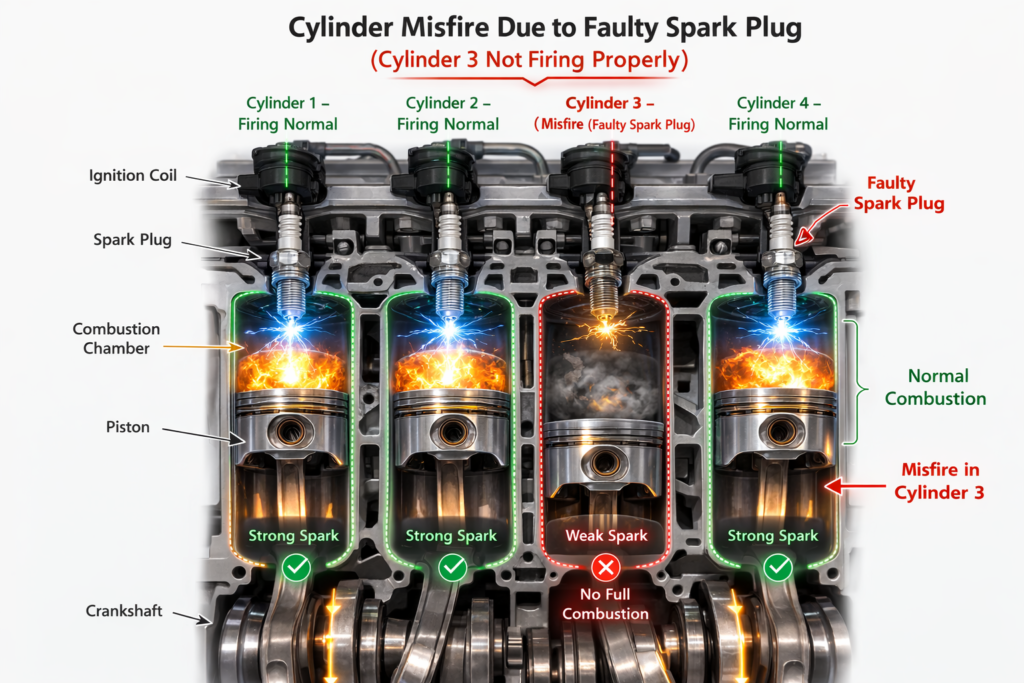
A misfire is a symptom, not the root problem. The actual engine misfire causes fall into three main categories: a bad spark (ignition system), a bad fuel mixture (fuel system), or a loss of compression (mechanical issue).
- Worn Spark Plugs: This is the #1 cause. Over time, the electrodes on a spark plug wear down, making it harder to create a strong spark. This is a primary cause of bad spark plug symptoms.
- Bad Ignition Coils: An ignition coil acts as a transformer, converting the car’s 12-volt power into the 20,000+ volts needed for the spark plug. If a coil fails, the spark plug for that cylinder gets no electricity.
- Fuel Injector Problems: A clogged or faulty fuel injector can fail to deliver the correct amount of fuel—or any fuel at all—to a cylinder, making combustion impossible.
- Vacuum Leaks: A crack in a vacuum hose or a leaky intake manifold gasket can let unmetered air into the engine. This throws off the precise air-to-fuel ratio, causing a “lean” misfire.
- Low Fuel Pressure: A failing fuel pump or a clogged fuel filter can reduce the pressure in the entire fuel system, starving all cylinders of the fuel they need and often causing a random misfire.
- Compression Problems: This is a more serious mechanical issue. Worn piston rings, a damaged valve, or a blown head gasket can cause a cylinder to lose compression, meaning it can’t properly compress the air-fuel mixture for ignition.
- Faulty Sensors: A bad Mass Airflow (MAF) sensor or Oxygen (O2) sensor can feed incorrect data to the ECU. The ECU then calculates the wrong fuel mixture, leading to misfires.
- Clogged Catalytic Converter: If the catalytic converter is blocked, it creates a traffic jam for exhaust gases trying to exit the engine. This backpressure can choke the engine and cause misfires.
Engine Misfire Codes Explained (P0300 – P0308)
When the check engine light comes on, an engine misfire diagnosis begins by reading the stored codes with an OBD2 scanner. Misfire codes are very specific:
- P0300 – Random/Multiple Cylinder Misfire Detected: The P0300 code meaning is that the misfire is happening on two or more cylinders, or the ECU can’t determine which specific cylinder is at fault. This often points to a problem affecting the whole engine, like a vacuum leak or low fuel pressure.
- P0301 – Cylinder 1 Misfire Detected
- P0302 – Cylinder 2 Misfire Detected
- P0303 – Cylinder 3 Misfire Detected
- P0304 – Cylinder 4 Misfire Detected
- …and so on for the number of cylinders in your engine (e.g., P0306 is for Cylinder 6).
These codes are incredibly helpful because they tell you exactly which cylinder to investigate. If you have a P0302 code, you can focus your testing on the spark plug, ignition coil, and fuel injector for cylinder #2.
Is It Safe to Drive With an Engine Misfire?
This is a critical question. The answer depends on the severity.
- If the Check Engine Light is solid: You might be able to drive a short distance to a repair shop. However, you are still causing some level of harm. Raw, unburned fuel is being washed over the cylinder walls, which can dilute the engine oil and accelerate wear.
- If the Check Engine Light is FLASHING: Pull over immediately and turn off the engine. A flashing light signals a severe misfire that is dumping large amounts of unburned fuel into the exhaust. This fuel will rapidly overheat and destroy your catalytic converter, turning a potentially simple repair (like a spark plug) into a repair that costs over $1,000.
Driving with a flashing check engine light is the fastest way to cause expensive, avoidable damage.
How Mechanics Diagnose Engine Misfires
As a mechanic, I follow a logical process to find the root cause efficiently. This is the same process you can start at home if you have an OBD2 scanner.
- Read OBD2 Codes: The very first step is to see what the ECU has to say. A code like P0304 immediately focuses the search on cylinder 4. This is the most crucial part of how to diagnose car problems at home.
- Inspect the Ignition System: For a specific cylinder misfire (e.g., P0304), the easiest thing to check first is the ignition system. A common trick is to swap the ignition coil from the bad cylinder (4) with a known good one (say, cylinder 1). Clear the codes and drive the car. If the code changes to P0301, you’ve proven the ignition coil is bad. If the code stays P0304, the coil is good, and you move on.
- Check Spark Plugs: The spark plug from the misfiring cylinder is removed and inspected. Is it black with carbon? Wet with fuel? Oily? The condition of the spark plug tells a story about what’s happening inside the cylinder.
- Test Fuel Injectors: If ignition isn’t the problem, the next step is to check the fuel injector. This can involve listening to it with a stethoscope to hear if it’s clicking or testing its electrical resistance.
- Check for Compression: If fuel and spark are good, the final step is to check for a mechanical problem with a compression test. This measures how well the cylinder can hold pressure and will reveal issues like bad piston rings or valves.
How to Fix an Engine Misfire
The fix is always to correct the underlying cause. Repair costs can vary dramatically.
| Repair | Typical Repair Cost (at a Shop) |
|---|---|
| Replacing Spark Plugs | $150 – $400 |
| Replacing a Single Ignition Coil | $120 – $350 |
| Cleaning or Replacing a Fuel Injector | $200 – $500 |
| Fixing a Vacuum Leak | $100 – $400 (highly variable) |
| Replacing a Fuel Pump | $400 – $1,000+ |
| Head Gasket Repair | $1,500 – $3,000+ |
How to Prevent Engine Misfires
An ounce of prevention is worth a pound of cure.
- Follow Your Maintenance Schedule: Replace your spark plugs at the interval recommended in your owner’s manual. This is the single most effective way to prevent misfires.
- Use Quality Fuel: Top-tier gasoline contains detergents that help keep your fuel injectors clean.
- Change Your Air Filter: A clogged air filter can restrict airflow and contribute to an improper fuel mixture.
- Don’t Ignore Small Problems: If you notice a rough idle or a drop in MPG, get it checked out. Small issues are cheaper to fix before they cause bigger ones.
Frequently Asked Questions
- What does an engine misfire feel like?
It usually feels like a shudder, shake, or vibration from the engine. You may also notice sluggish acceleration, a rough idle, and a change in the engine’s sound. - Can bad spark plugs cause engine misfires?
Yes, absolutely. Worn-out or fouled spark plugs are the most common cause of engine misfires. - Is an engine misfire expensive to fix?
It can be. A simple spark plug replacement is relatively inexpensive, but if the misfire is caused by a mechanical issue like a bad head gasket, the repair can be very costly. This is why early diagnosis is so important. - Can low fuel pressure cause a misfire?
Yes. If the fuel pump isn’t supplying enough pressure, the fuel injectors can’t deliver enough fuel for proper combustion, leading to a lean misfire. - What code indicates a cylinder misfire?
Codes from P0301 to P0308 indicate a misfire on a specific cylinder. For example, P0301 is a misfire on cylinder 1. The code P0300 indicates a random misfire on multiple cylinders. - Can I drive with a misfiring engine?
You should not. If the check engine light is solid, drive cautiously to a nearby mechanic. If the light is flashing, pull over immediately to prevent catastrophic damage to your catalytic converter.
Final Advice
An engine misfire is your car’s way of asking for help. While the symptoms can be alarming, they provide valuable clues to what’s going on under the hood. By listening to your car and taking action quickly, you can often solve the problem before it becomes a major, wallet-draining headache. Never ignore a misfire, and absolutely never drive with a flashing check engine light. A little attention now can keep your car running reliably for many miles to come.