
Key Takeaways:
- A faulty gas cap is a $20 fix that causes zero driveability issues, while a bad O2 sensor is a $300+ repair that actively destroys your fuel economy.
- If your car runs perfectly but the light is on, check the gas cap first; if the engine idles roughly or smells like “rotten eggs,” the O2 sensor or catalytic converter is likely to blame.
- An OBD2 scanner is the only way to be 100% certain, identifying specific codes like P0455 (Large Leak) for gas caps or P0130 (Circuit Malfunction) for sensors.
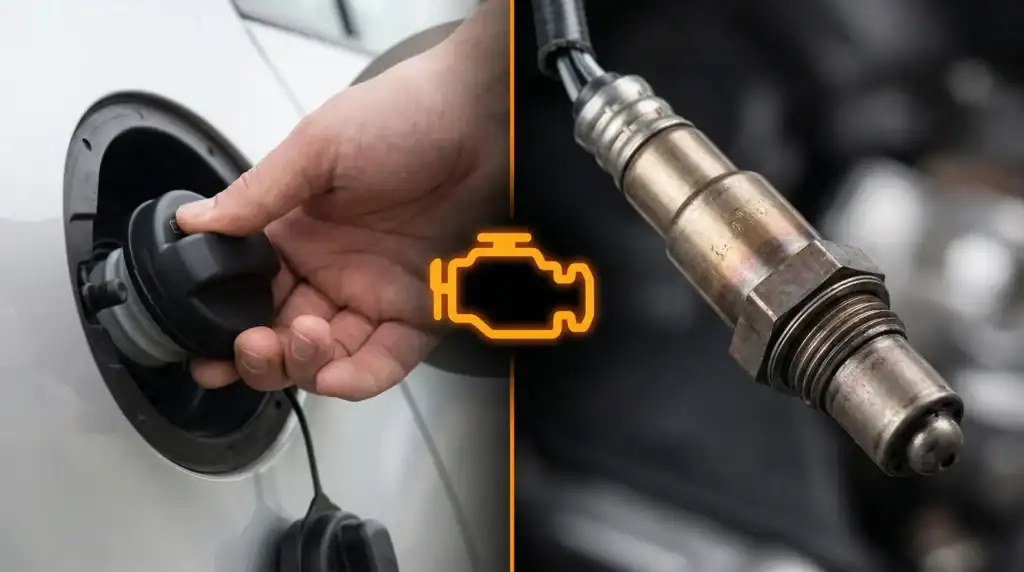
The “Price Gap” Hook: A $20 Fix or a $300 Headache?
When the check engine light (CEL) illuminates, most drivers anticipate a massive repair bill. However, two of the most common triggers sit at opposite ends of the financial spectrum. A loose or damaged gas cap is a $0 to $30 fix that you can perform in seconds. Conversely, an Oxygen (O2) sensor failure typically costs between $150 and $400 and often requires specialized tools or professional labor.
While both trigger the exact same amber warning on your dashboard, their impact on your vehicle’s health and your wallet couldn’t be more different. At CarLogicLab, we see thousands of drivers pay $100+ diagnostic fees for a “repair” that consists of simply tightening a plastic cap. This guide will help you bridge that “Tool Gap” and identify the culprit before you open your wallet.
Symptom Breakdown: How They Feel on the Road
The Gas Cap (EVAP System) ⚠️
The gas cap is a critical part of your car’s Evaporative Emission (EVAP) system, designed to trap fuel vapors before they escape into the atmosphere.
- The “Invisible” Symptom: Most interestingly, a faulty gas cap usually presents no driveability symptoms. Your car will start, accelerate, and idle perfectly.
- The Refueling Trigger: Did the light turn on within 20–50 miles of your last trip to the gas station? This is the strongest indicator of a loose cap.
- The Faint Smell: Occasionally, you may notice a faint scent of raw gasoline near the rear of the vehicle after it has been parked.
The O2 Sensor (Combustion Monitor) 🚨
Your Oxygen sensors are the “eyes” of the engine, constantly measuring the amount of unburned oxygen in the exhaust to adjust the fuel-to-air ratio. When they fail, the engine enters a “fail-safe” or “rich” mode.
- Performance Loss: Unlike a gas cap, a bad O2 sensor causes noticeable issues. You may experience a car shaking while driving or a rough idle.
- MPG Drop: Because the computer can no longer fine-tune fuel delivery, your fuel economy can drop by as much as 40%.
- The “Rotten Egg” Smell: If the sensor failure causes the engine to run too “rich” (too much fuel), it can overheat the catalytic converter, producing a sulfurous, rotten egg smell.
Quick Comparison Table
| Feature | Gas Cap (EVAP) | Oxygen (O2) Sensor |
| Driveability | Feels Normal ✅ | Rough Idle / Stalling ⚠️ |
| Fuel Economy | No Change ✅ | Significant Drop (up to 40%) 🚨 |
| Common Trigger | After Refueling | High Mileage / Age |
| Est. Repair Cost | $0 – $30 | $150 – $400 |
| DIY Difficulty | Very Easy | Moderate |
| Risk Level | Low (Emissions only) | High (Can ruin Catalytic Converter) |
The “At-Home Test”: Actionable DIY Steps
Before heading to a shop, perform these two CarLogicLab-approved tests to rule out the cheap fix.
1. The Visual & Tactile Inspection
Remove your gas cap and inspect the thick rubber O-ring (the seal).
- What to look for: Look for fine cracks, dry rot, or debris on the seal surface.
- The “Click” Test: Reinstall the cap. It should click firmly. If it feels “mushy” or doesn’t click at all, the internal ratcheting mechanism is broken.
2. The Drive Cycle Reset
If you found the cap was loose and tightened it, the light will not turn off immediately.
- The Method: You must complete a “Drive Cycle.” This typically involves 50–100 miles of mixed city and highway driving over 2–3 days. If the cap was the issue, the computer will see the system is now sealed and extinguish the light naturally.
- Detailed Guide: How to Reset a Check Engine Light Without a Scanner
The OBD2 Tie-In: 100% Certainty
While symptoms provide clues, modern cars are complex. A “Small EVAP Leak” could be a gas cap, but it could also be a cracked charcoal canister hose. The only way to be 100% sure is to use a scanner.
Identifying the Codes
When you plug in a scanner, look for these specific code families:
- Gas Cap / EVAP Codes: P0440, P0442, P0455, P0457. (P0457 specifically means “Loose Fuel Cap Detected”).
- O2 Sensor Codes: P0130 through P0161. These codes will often specify “Bank 1” or “Bank 2,” telling you exactly which sensor is failing.
CarLogicLab Pro-Tip: Don’t replace the O2 sensor until you’ve ruled out the gas cap—it’s the most common DIY mistake. Many EVAP codes can mimic sensor lean/rich codes. Always check the fuel system integrity first.
The Smart Solution: Own the Diagnostic
Instead of guessing or “parts-cannon” repairing (replacing parts randomly), we recommend owning a basic diagnostic tool. A $50–$100 scanner pays for itself the very first time it saves you from a $120 mechanic “hook-up” fee.
- Our Recommendation: For the best balance of ease and accuracy, see our guide on the Top 5 Car Diagnostic Scanners for 2026.
- Immediate Fix: If your inspection confirmed a brittle seal, grab a Universal Replacement Gas Cap to seal your system and get your MPG back on track.
When to See a Professional
If your scanner reveals O2 sensor codes and you notice your car losing power while accelerating, do not wait. A failing O2 sensor can eventually lead to a Catalytic Converter failure, which costs upwards of $2,000.
Related Resources:
- Pillar Page: Check Engine Light On? 7 Causes, What It Means & What To Do
- Cluster Page: How to Reset a Check Engine Light Without a Scanner