
Key Takeaways:
- Manual resets clear the warning light but do not fix the underlying mechanical fault.
- Driving a “Drive Cycle” (50–100 miles) is the only way to clear the light naturally and safely.
- A manual reset (like disconnecting the battery) will cause an immediate failure at an emissions or smog station until the car’s computer recalibrates.
⚠️ WARNING: Read This Before You Reset
Before attempting to clear your dashboard, you must determine the urgency of the alert. At CarLogicLab, we categorize engine lights into two categories:
- The Solid Light ⚠️: A non-emergency emissions or sensor fault. You can safely attempt a reset if the car is driving normally.
- The Blinking Light 🚨: A severe engine misfire. Do not attempt to reset this. Resetting a blinking light without fixing the cause can lead to a melted catalytic converter or permanent engine failure within miles.
The “CarLogicLab Diagnostic Logic”: Why Reset a check engine light?
There are legitimate reasons to reset a light without a scanner. Perhaps you just replaced a faulty oxygen sensor and don’t want to wait days for the light to clear, or maybe a loose gas cap triggered a “ghost code” that won’t go away.
However, remember the Diagnostic Gap: When you reset the light manually, you are essentially “muting the smoke alarm” without checking for fire. For a professional-grade solution that tells you why the light is on, skip the guesswork and see our guide to the Top 5 Car Diagnostic Scanners for 2026.
Method 1: The Drive Cycle Method (The Safest Way)
The “Drive Cycle” is the only method endorsed by manufacturers. It allows the Engine Control Unit (ECU) to perform its own diagnostic “self-test” to verify the vehicle is operating within parameters.
How to Complete a Drive Cycle:
To reset the light naturally, you must drive the car under specific conditions, usually involving:
- Cold Start: Let the engine idle for 2-3 minutes.
- Steady Speed: Drive at 50–60 mph for 15 minutes on a highway (avoiding aggressive acceleration).
- City Driving: 20 minutes of stop-and-go traffic with at least 4 idle periods.
- Distance: Generally, 50 to 100 miles are required.
The Result: If the fault was temporary (like a one-time sensor glitch), the ECU will see the “Good” data and turn the light off automatically. This is the only way to ensure your car is “Ready” for an emissions test.
Method 2: The Gas Cap Reset (The #1 “Ghost Code” Fix)
Your car’s Evaporative Emission (EVAP) system is incredibly sensitive. If the gas cap isn’t tight, the system detects a pressure leak and triggers the check engine light.
The Step-by-Step Fix:
- Inspect the Seal: Remove the cap and check the rubber gasket for cracks or debris.
- Tighten: Reinstall and turn until it clicks loudly.
- Wait: Most cars require three successful drive cycles to clear an EVAP-related light.
If the light stays on after a week of driving, the leak may be elsewhere in the fuel system, such as a cracked hose or a faulty purge valve. See our Check Engine Light On? 7 Causes, What It Means & What To Do for deeper troubleshooting.
Method 3: The Battery Disconnect (The “Hard Reset”)
This is the most common DIY “hack,” but it comes with significant trade-offs. By cutting power, you force the computer to reboot and clear any stored active codes.
🚨 Physical Safety Check: > Before touching the battery, ensure the engine is off and the key is completely removed from the ignition. This prevents accidental electrical surges or sparking that can damage sensitive ECU components.
Execution Steps:
- Safety Gear: Wear gloves and eye protection.
- Negative First: Use a wrench to loosen the nut on the Negative (-) Black Terminal. Pull the cable off and tuck it aside.
- Discharge the System: Wait 15 to 30 minutes to allow capacitors to drain.
- Reconnect: Secure the negative cable back onto the terminal.
The Major Downside: This resets everything. You will lose your radio presets, clock settings, and Bluetooth pairings.
Method 4: The Ignition Key Cycle (Legacy Vehicles)
Many older domestic vehicles (specifically Chrysler, Jeep, and older Ford/GM models) have a built-in sequence to reset or display codes without a tool.
The 3-5 Cycle Sequence:
- Insert your key into the ignition.
- Turn the key to the “ON” position (the dash lights up, but the engine does not start).
- Turn it back to “OFF.”
- Repeat this 3 to 5 times rapidly.
On some models, this resets the internal “check” counter. On others, it will actually flash the check engine light in a pattern (e.g., two flashes, then three flashes) to tell you the specific fault code.
Method 5: Pulling the ECU Fuse
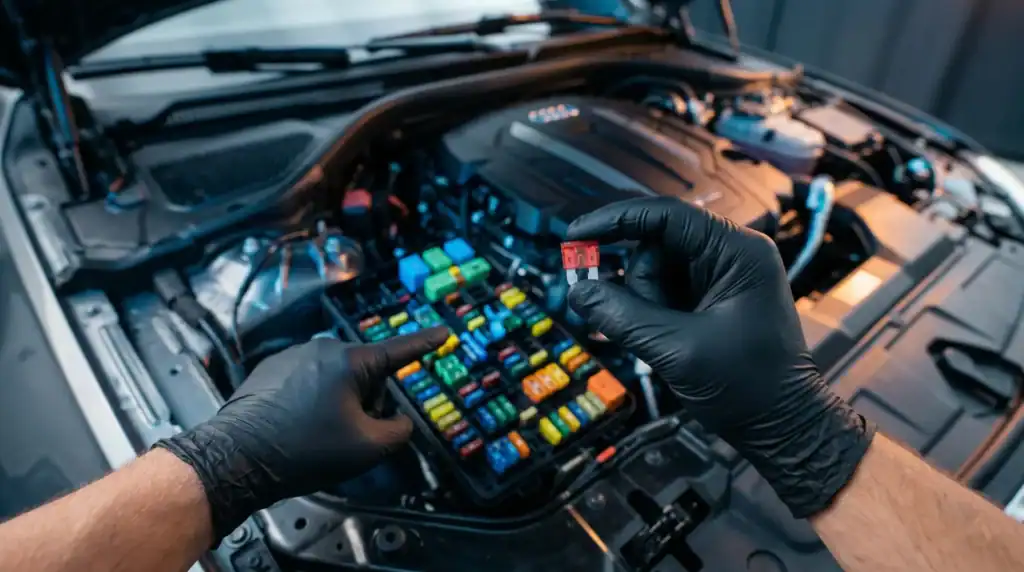
If you want to reset the engine computer without losing your radio stations and seat memory, you can perform a “surgical” reset by pulling the dedicated fuse.
🚨 Physical Safety Check: > Always ensure the ignition is in the “OFF” position before removing or inserting fuses. Pulling a live fuse can cause a small arc (spark) that may blow the fuse or damage the fuse box terminals.
How to Locate the Fuse:
- Find your fuse box (usually under the hood in a plastic black box).
- Refer to the diagram on the underside of the lid.
- Look for a fuse labeled “ECU,” “ECM,” or “Engine Control Module.”
- Use the plastic fuse puller tool to remove it for 10 minutes.
Why Manual Resets Often Fail (The “Not Ready” Trap)
[Placeholder: Image of an OBD2 scanner screen showing “Readiness Monitors Not Ready”]
The biggest mistake DIYers make is resetting the light right before a state inspection. When you disconnect the battery or pull a fuse, you clear the “Readiness Monitors.”
Modern emissions stations don’t just check if the light is OFF; they check if the car has completed its self-tests. If you show up with a “blank” computer, the technician will tell you the car is “Not Ready,” and you will have to drive another 100 miles and pay for a re-test.
Pro-Tip: If you are trying to pass an inspection, do not manually reset the light. Use an OBD2 scanner to fix the specific fault, then let the light clear itself naturally.
The “Smart Fix”: Why a Scanner is Better
Manual resets are essentially a blindfold. You are clearing a warning without knowing if your car is losing power while driving due to a $20 sensor or a $2,000 engine failure.
For the price of a tank of gas, you can own a tool that tells you exactly what is wrong.
- Our Top Pick: The BlueDriver Bluetooth Professional OBDII Scan Tool. It plugs into your car, syncs to your phone, and provides a list of “Verified Fixes.”
- The Savings: A $50–$100 scanner pays for itself the very first time you use it by skipping the $120 “Diagnostic Fee” at the dealership.
Check out our full breakdown: Best OBD2 Scanners of 2026.
When to Give Up and See a Pro
If the light returns immediately after a reset, you have a “Hard Fault.” Common symptoms that require a professional mechanic include:
- The car shaking while driving (potential misfire).
- The car starts then dies immediately (fuel or airflow issue).
- A strong smell of rotten eggs (catalytic converter failure).
Internal Resource: For more help on specific codes, visit our guide: Will My Car Pass Emissions With a Solid Check Engine Light?] or return to our Check Engine Light On? 7 Causes, What It Means & What To Do for a full diagnostic checklist.