
Noticing an unusual smell coming from your car can be an unsettling experience. Of all the strange scents a vehicle can produce, a burning odor is perhaps the most concerning. It immediately makes you wonder if something is seriously wrong, but there is no need to jump to the worst-case scenario. A car smells like burning is your vehicle’s way of communicating, and more often than not, it’s pointing to a manageable issue.
The first step is not to panic, but to observe. This guide is designed to help you do just that. We will calmly walk through the common sources of burning odors, what they might mean, and what you can safely check on your own. This article is not about performing complicated repairs; it’s about building your understanding and confidence so you can take the right next steps.
Let’s investigate what that smell might be trying to tell you.
Table of Contents
What a Burning Smell Usually Means
At its most basic level, a car smells like burning means that something is getting hotter than it should. This heat can be caused by three primary factors: friction between moving parts, a hot engine component making contact with a fluid it shouldn’t, or an electrical short circuit.
Think of it like cooking. If a drop of olive oil spills onto a hot stove burner, it will smoke and create a distinct smell. If you leave a pan on the heat for too long, it will start to smell burnt. Your car operates on similar principles. A burning odor is simply a symptom that a part or fluid is being exposed to excessive heat.
While some smells can indicate an urgent problem, many are warnings that give you time to investigate. The most important thing you can do is pay attention to the specific type of smell, when it happens, and where it seems to be coming from. This act of observation is the foundation of figuring out what is going on with your vehicle.
Common Signs Drivers Notice
A “burning smell” isn’t a single scent; it can have different characteristics depending on the source. Identifying the specific odor is a crucial clue. See if any of these common descriptions match what you are experiencing:
- A sharp, acrid smell like burning plastic or rubber. This often happens after you’ve been driving for a while or during heavy braking.
- A thick, oily smell, similar to burnt cooking oil. This odor may be most noticeable when the car is stopped at a light or after you have parked and shut off the engine.
- A scent like burnt carpet or fabric. This is a unique smell that many people associate with brake or clutch issues.
- A pungent, chemical odor accompanied by a “hot” smell. This is often a sign of an overheating engine.
- A distinct electrical burning smell, like overheated wiring. This is a sharp scent that should be taken very seriously.
- The smell only appears when the heater or air conditioning is running.
- The odor is strongest outside the car, near the wheels or under the hood.
Making a mental note of these details will help you narrow down the potential causes and have a more productive conversation if you need to speak with a technician.
5 Common Causes Explained
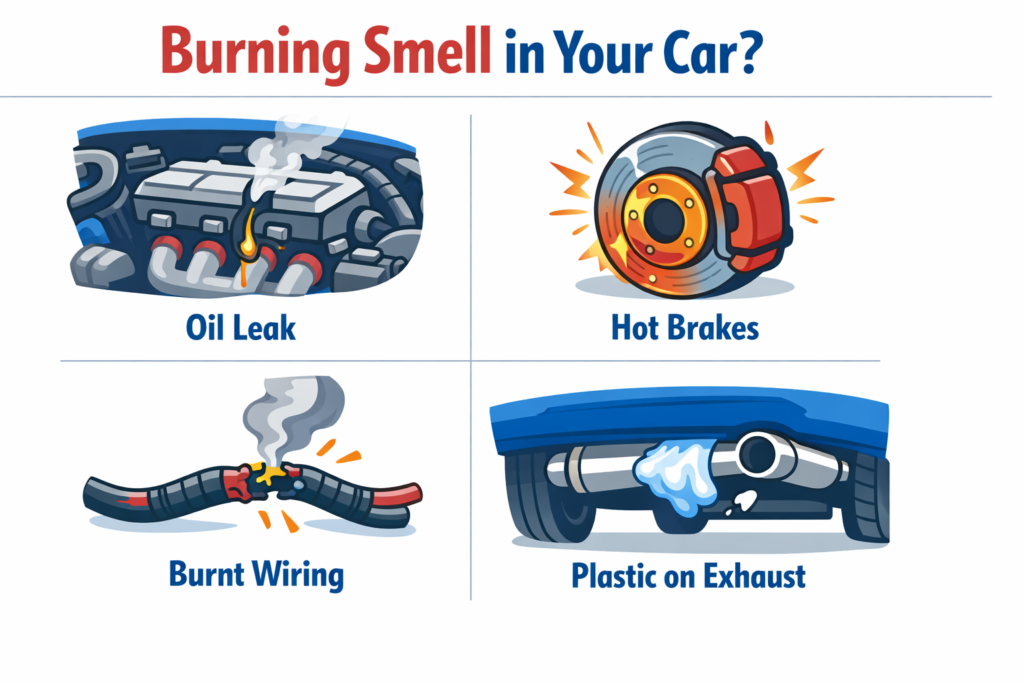
Let’s explore the most frequent reasons your car smells hot while driving, broken down into simple, beginner-friendly terms.
Reason #1 — Oil or Fluid Contact
One of the most common culprits for a burning odor is a fluid leak. Your engine bay contains several hot components, including the exhaust manifold. If a fluid like engine oil or transmission fluid leaks from a worn gasket or seal and drips onto these hot surfaces, it will instantly burn off, creating a noticeable smell.
This is often described as a thick, acrid smell of burning oil. You might notice it most after the car has been running for a while and is fully warmed up. Sometimes, you may even see a small puff of blue or white smoke rising from under the hood when you are stopped. While any fluid leak needs to be addressed, a minor one of this type is not typically an immediate emergency.
Reason #2 — Overheating Components
Your car’s engine operates within a specific temperature range, managed by the cooling system. If the engine starts to overheat due to a low coolant level, a failing thermostat, or other cooling system problems, the engine itself can get too hot.
This can create a “hot” smell, often accompanied by a slightly sweet scent if the cause is burning coolant leaking from a hose. If you notice this smell, you should immediately look at the temperature gauge on your dashboard. If it is climbing into the red zone, it’s a clear signal to pull over as soon as it is safe to do so to prevent severe engine damage.
Reason #3 — Brake System Heat
Your car’s brakes work through intense friction. When you press the brake pedal, the brake pads clamp down on spinning discs (rotors). This friction creates a massive amount of heat to slow you down. Under normal conditions, this heat dissipates without issue.
However, if a brake caliper is stuck, it can cause the brake pad to remain in constant contact with the rotor, even when you aren’t braking. This constant friction generates extreme heat, leading to a very sharp, pungent smell similar to burning carpet. You might notice this smell is strongest near one of the wheels, and that wheel may feel significantly hotter than the others after a drive. Another cause is “riding the brakes,” especially when driving down a long, steep hill, which can also overheat the system.
Reason #4 — Electrical or Wiring Issues
An electrical burning smell is one of the most serious odors you can encounter. It is often described as smelling like burnt plastic or toast and indicates that a wire’s insulation is melting due to a short circuit or an overloaded circuit.
This can be caused by anything from a faulty accessory to a problem with the main wiring harness. An electrical smell can be a fire hazard and should be investigated immediately. You might notice the smell when you turn on a specific feature, like the heater fan or the headlights, or it might appear randomly. It is often the first and only warning before a component stops working entirely.
Reason #5 — Debris or Foreign Material
Sometimes, the source of the burning smell isn’t part of your car at all. It is surprisingly common for road debris to get kicked up into the undercarriage and make contact with the hot exhaust system.
A plastic bag, fallen leaves, or a piece of road tar can easily get stuck to your exhaust pipe. As the exhaust heats up to several hundred degrees, this material will melt or smolder, producing a strong burning plastic or organic smell. The odor will typically be strongest when you first stop the car after a drive and may disappear on its own after the debris has completely burned away.
What You Should Check First (Step-by-Step)
Before you worry, take a moment to be an observer. These safe, simple checks can provide valuable clues without you needing to touch anything mechanical.
- Note the Timing: When does the smell appear? Only when braking? When the heater is on? After driving at high speeds? The timing is your most important clue.
- Identify the Smell: Try to pinpoint the character of the scent. Is it oily, plastic, rubbery, or electrical? As we’ve discussed, each points toward different systems.
- Look at Your Gauges: Check your dashboard. Is the temperature gauge high? Are any warning lights illuminated? This is your car’s primary way of telling you something is wrong.
- Perform a Walk-Around: Once you’ve parked in a safe place, walk around the car. Is the smell stronger near a specific wheel? This could indicate a brake issue. Is it strongest at the front? This points toward the engine bay.
- Look Under the Car: From a safe distance, look under the engine bay for any signs of dripping fluid. A fresh puddle of black or brown fluid is a good indicator of an oil leak.
- Consider Your Recent Drive: Did you just drive through an area with a lot of fallen leaves? Did you run over a plastic bag in the road? Sometimes the answer is related to your environment.
This process is the first step in diagnosing car problems at home and helps you gather the facts.
When to Stop Driving
While many smells are just warnings, some require immediate action to ensure your safety and prevent catastrophic damage. Pull over and turn off the engine as soon as it is safe if you notice:
- Any visible smoke coming from under the hood or from the dashboard.
- A strong electrical burning smell inside the cabin.
- A burning smell accompanied by a temperature gauge in the red zone.
- The check engine light or oil pressure light is flashing.
- The smell is accompanied by loud grinding, banging, or other unusual mechanical noises.
These are signs of a serious problem that could lead to a fire or complete engine failure. It is not safe to continue driving.
How a Basic Tool Can Help
For issues that trigger a dashboard warning light, a simple diagnostic tool can provide incredible insight. Modern cars are equipped with an On-Board Diagnostics (OBD2) port, usually located under the dashboard on the driver’s side.
By plugging in a simple device, you can read the “trouble codes” that the car’s computer has stored. For example, if a sensor related to the cooling system is failing and causing an overheating condition, the scanner will tell you. This takes the guesswork out of the equation. For those new to auto care, using one of the best OBD2 scanners for beginners is an empowering, easy, and affordable way to better understand your vehicle’s health without getting your hands dirty.
Frequently Asked Questions
Is a burning smell from a car dangerous?
Sometimes. Minor causes like debris may be harmless, but electrical smells, smoke, or overheating should be treated seriously.
Can I keep driving if my car smells like burning?
If there are no warning lights, smoke, or overheating, short-distance driving may be fine — but investigate promptly.
Why does my car smell burnt after braking?
Brake friction generates heat. Heavy braking or a sticking caliper can produce a burnt smell.
Will a burning smell trigger a check engine light?
Not always. However, related issues such as overheating or sensor faults may activate one.
Final Thoughts
A burning smell from your car is a signal that deserves your attention, but it is rarely a reason for immediate panic. By approaching the situation with calm observation, you can turn a moment of anxiety into an opportunity for understanding. You now know the difference between the smell of burning oil, an overheating brake, and a potential electrical issue.
This knowledge is a powerful tool. It helps you assess the situation, gather information, and make an informed decision about what to do next. It transforms you from a worried passenger into a confident and aware driver, fully in tune with your vehicle’s language.