
You get in your car, turn the key, and… rur-rur-rur. The engine cranks, but it doesn’t catch. You try again. More cranking. Finally, on the third or fourth attempt, it sputters to life. If your car takes multiple tries to start, it can be a frustrating and nerve-wracking way to begin your day. But while it’s certainly an inconvenience, it’s often a sign of a manageable issue, not a catastrophe.
There’s no need to immediately assume the worst. Your car is simply telling you that one of the key ingredients for a successful start is a little off balance. This guide will calmly walk you through what’s happening behind the scenes, the common reasons for a delayed start, and the simple, safe observations you can make. This isn’t about teaching you to be a mechanic; it’s about helping you understand your car’s language.
Table of Contents
Why Your Car Takes Multiple Tries to Start — Causes Explained
For your engine to roar to life, it needs three things at the perfect moment: fuel, air, and a spark. Think of it like lighting a barbecue. You need the fuel (propane or charcoal), the air (oxygen), and a spark from the igniter. If you have too little gas, or if the igniter is weak, it might take a few clicks to get the flame going.
Your car works on the same principle. A “hard start” or multiple cranking attempts usually means there’s a delay or weakness in one of these three areas. The starter motor is turning the engine over (the rur-rur-rur sound), but the fuel, air, and spark aren’t creating combustion right away. Our goal is to figure out which part of that recipe is causing the delay.
Common Signs Drivers Notice
When a car is hard to start, it can present itself in a few different ways. See if any of these common symptoms sound familiar:
- The engine cranks for several seconds before finally starting.
- You hear a rapid clicking sound, but the engine doesn’t turn over at all.
- The cranking sounds sluggish and slow, especially when the car is cold.
- The dashboard lights flicker or dim while you’re trying to start the engine.
- You notice a distinct smell of gasoline after a failed starting attempt.
- The problem is worse in the morning but seems to get better after the car has been running.
Pinpointing these specific signs is the first step in diagnosing car problems at home.
Why Your Car Takes Multiple Tries to Start (5 Most Likely Culprits)
If your engine cranks repeatedly before finally “catching,” your vehicle is failing a basic diagnostic health check. While a total “no-start” is a complete failure, a “hard-start” is a warning. Here are the five mechanical systems most likely causing the delay.
Reason #1 — Voltage Drop: Weak Battery or Corroded Terminals
The starting process is the most electrically demanding task your car performs. A battery doesn’t just “work” or “not work”; it exists on a spectrum of health.
- The Technical Cause: A healthy battery should read 12.6V when the car is off. As batteries age, their internal resistance increases. They may have enough voltage to power your radio (low amperage), but the moment the starter motor demands high amperage, the voltage “drops” below the threshold required to fire the fuel injectors and the ECU.
- The Symptoms: You will hear a “slow, labored” crank (rur… rur… rur). If your dashboard lights flicker or your clock resets after a hard start, you are experiencing a significant voltage drop.
- The DIY Fix: Use a Digital Multimeter to check your resting voltage. If it’s below 12.2V, your battery is likely at the end of its life.
Reason #2 — Fuel Pressure Loss (The ‘Key Dance’ Test)
Fuel doesn’t just sit in the lines; it must be held under high pressure even when the engine is off. If that pressure “bleeds back” into the tank, the engine must crank for several seconds just to prime the lines again.
- The Technical Cause: Most modern fuel systems use a Check Valve or a Fuel Pressure Regulator to maintain line pressure. If these components leak, the fuel drains away from the engine.
- The “Key Dance” Diagnostic: To confirm this at home, turn your ignition to the ‘ON’ position (don’t start the engine) for 3 seconds, then turn it ‘OFF’. Repeat this 3 times. This manually cycles the fuel pump to prime the lines. If the car starts perfectly after this “dance,” your fuel pump’s check valve is failing.
- The Symptoms: The engine cranks at a healthy, fast speed but takes 5–10 seconds to actually fire up.
Reason #3 — Fouled Spark Plugs or Ignition Coil Resistance
Even with perfect fuel and air, a weak spark will fail to ignite the mixture on the first few compression strokes, especially during a cold start.
- The Technical Cause: Over time, the gap on your spark plugs widens. A wider gap requires higher voltage from the ignition coil to jump. On the first try, the coil may not reach that threshold. Additionally, carbon buildup on the plug (fouling) can “shroud” the spark, preventing ignition until the cylinder clears out after a few rotations.
- The Symptoms: The car sways or “stumbles” into life. Once it starts, you may notice a rough idle for the first 30 seconds as the unburned fuel is cleared.
- The Fix: Check for a P0300 or P0301-P0304 code using an OBD2 scanner; these often accompany ignition-based starting issues. Check our dedicated article Top 5 Car Diagnostic Scanners for 2026
Reason #4 — Faulty Engine Sensors (ECT or Crankshaft)
Your car’s computer (ECU) acts like a digital choke. It needs to know the exact temperature and position of the engine to calculate the correct fuel-to-air ratio.
- The Technical Cause: The Engine Coolant Temperature (ECT) sensor is vital. If it fails and reports that the engine is “Hot” when it is actually “Cold,” the ECU won’t provide the “rich” fuel mixture needed for a cold start. Similarly, a failing Crankshaft Position Sensor may struggle to send a signal to the ECU while the engine is at low cranking RPMs, only “waking up” after a few tries.
- The Symptoms: The starting issue is inconsistent. It might start perfectly when the engine is warm but take five tries in the morning (or vice versa).
Reason #5 — Environmental Variables: Cold Cranking Amps & Vapor Lock
Sometimes the issue isn’t a broken part, but physics working against your vehicle’s current condition.
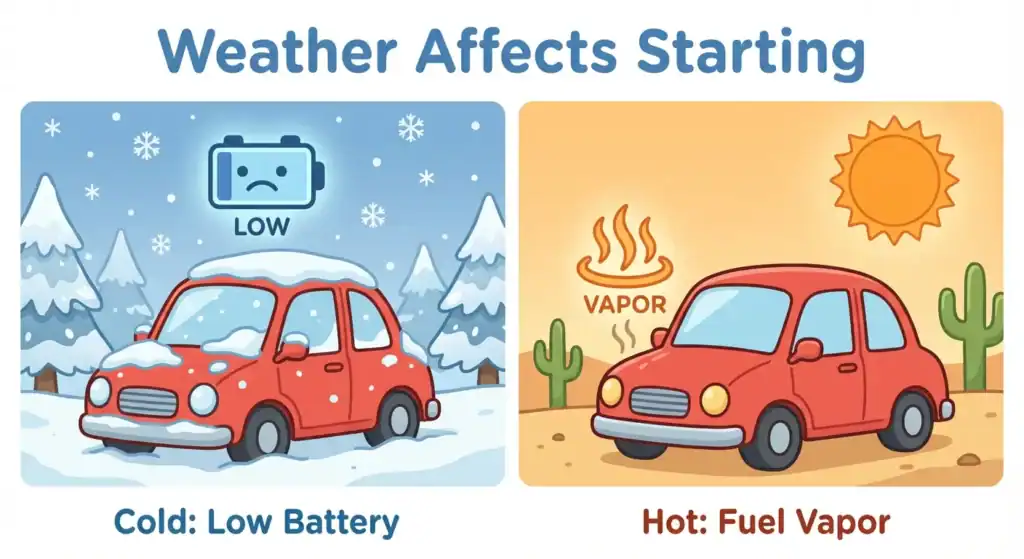
- The Technical Cause: In Extreme Cold, engine oil thickens like molasses, creating physical resistance that the starter motor must fight. Simultaneously, the chemical reaction inside your battery slows down, reducing its Cold Cranking Amps (CCA). In Extreme Heat, fuel can actually turn into a gas (vapor) inside the fuel rail before it reaches the injectors. This is known as Vapor Lock, and the engine cannot run on fuel vapor; it must wait for liquid fuel to arrive.
- The Symptoms: Difficulty starting specifically during the first freeze of winter or after the car has been sitting in a 100°F (38°C) parking lot for hours.
What You Should Check First (Step-by-Step)
You can gather a lot of information without ever opening the toolbox. Perform these simple, safe checks:
- Listen Carefully: Pay attention to the sound. Is it a rapid clicking? A slow, sluggish crank? Or a normal-speed crank with no result? The sound is a major clue.
- Look at the Dashboard: When you turn the key, do the dashboard warning lights explained on your dash dim significantly or go out completely? This often points to a battery issue. Is the check engine light on?
- Check for Obvious Signs: Look at the battery terminals. Do you see any fuzzy, blue-green, or white corrosion? That can block the electrical connection.
- Try This Trick: Turn the key to the “On” position (without starting) and wait 3-4 seconds. You might hear a faint humming sound—that’s the fuel pump priming the system. Turn the key off, then on again. After doing this two or three times, try to start the engine. If it starts right up, it strongly suggests a fuel delivery issue.
- Note the Pattern: Does this only happen in the morning? Only when it’s cold? Or is it completely random? Keeping a mental log will be incredibly helpful if you need to talk to a mechanic. One of the best OBD2 scanners for beginners can also help you read any trouble codes.
When to Stop Trying and Get Help
While it’s usually okay to try starting the car a few times, you should stop and call for professional help if you notice any of these red flags:
- You smell a very strong odor of gasoline.
- You see or smell smoke coming from under the hood.
- The electrical systems (lights, radio) are completely dead.
- A loud grinding noise occurs when you turn the key.
- The engine fails to start after 5 or 6 repeated attempts.
Continuing to crank the engine can potentially damage the starter motor or other components.
Frequently Asked Questions
Why does my car struggle to start in the morning?
This is often due to a weak battery that loses charge overnight or because cold weather is making the engine oil thicker and the battery less effective.
Can a weak battery cause multiple cranking attempts?
Absolutely. A battery may have enough power to crank the engine slowly but not enough to do it fast enough for a quick start, leading to several tries.
Is it safe to keep trying to start the engine?
You can safely try a few times. However, if the car doesn’t start after 5-6 attempts, it’s best to stop. Excessive cranking can overheat and damage the starter motor and drain any remaining power from the battery.
Does temperature affect starting reliability?
Yes, both cold and hot weather can make starting more difficult. Cold reduces battery efficiency and thickens oil, while extreme heat can sometimes affect fuel delivery.
Final Thoughts
A car that takes a few tries to start is a puzzle, not a panic attack. You are now equipped with the knowledge to understand the clues your car is giving you. By calmly observing the sounds, sights, and patterns, you’ve taken the first and most important step toward a solution.
You don’t need to have the answer, but understanding the question is powerful. It builds your confidence and allows you to be an active partner in your car’s health, turning a moment of frustration into one of empowered understanding.