
You get in your car, turn the key, and… rur-rur-rur. The engine cranks, but it doesn’t catch. You try again. More cranking. Finally, on the third or fourth attempt, it sputters to life. If your car takes multiple tries to start, it can be a frustrating and nerve-wracking way to begin your day. But while it’s certainly an inconvenience, it’s often a sign of a manageable issue, not a catastrophe.
There’s no need to immediately assume the worst. Your car is simply telling you that one of the key ingredients for a successful start is a little off balance. This guide will calmly walk you through what’s happening behind the scenes, the common reasons for a delayed start, and the simple, safe observations you can make. This isn’t about teaching you to be a mechanic; it’s about helping you understand your car’s language.
Table of Contents
Why Your Car Takes Multiple Tries to Start — Causes Explained
For your engine to roar to life, it needs three things at the perfect moment: fuel, air, and a spark. Think of it like lighting a barbecue. You need the fuel (propane or charcoal), the air (oxygen), and a spark from the igniter. If you have too little gas, or if the igniter is weak, it might take a few clicks to get the flame going.
Your car works on the same principle. A “hard start” or multiple cranking attempts usually means there’s a delay or weakness in one of these three areas. The starter motor is turning the engine over (the rur-rur-rur sound), but the fuel, air, and spark aren’t creating combustion right away. Our goal is to figure out which part of that recipe is causing the delay.
Common Signs Drivers Notice
When a car is hard to start, it can present itself in a few different ways. See if any of these common symptoms sound familiar:
- The engine cranks for several seconds before finally starting.
- You hear a rapid clicking sound, but the engine doesn’t turn over at all.
- The cranking sounds sluggish and slow, especially when the car is cold.
- The dashboard lights flicker or dim while you’re trying to start the engine.
- You notice a distinct smell of gasoline after a failed starting attempt.
- The problem is worse in the morning but seems to get better after the car has been running.
Pinpointing these specific signs is the first step in diagnosing car problems at home.
5 Common Causes Explained
Let’s explore the most frequent culprits behind a car that struggles to start.
Reason #1 — Weak Battery or Electrical Strain
This is one of the most common causes. The battery provides the initial jolt of electricity needed to power the starter and the rest of the electrical system.
- What it is: Over time, car batteries lose their ability to hold a full charge. A weak or aging battery might have just enough power to turn on the lights and radio, but not enough to crank the engine over with vigor. Corroded or loose battery terminals can also restrict the flow of electricity.
- What you might feel: The engine cranking sounds slow and lazy (rur… rur… rur). Your headlights and dashboard lights may appear dim or flicker as you turn the key.
Reason #2 — Fuel Delivery Irregularities
If the engine isn’t getting the right amount of fuel at the right time, it will struggle to start.
- What it is: The issue could be a weak fuel pump that isn’t sending enough fuel to the engine, or a clogged fuel filter that’s restricting the flow. In some cases, a leaky fuel injector can cause the system to lose pressure when the car is off, requiring a few cranks to build it back up.
- What you might feel: The engine cranks at a normal speed but just won’t catch. You might smell gasoline because unburned fuel is accumulating. Sometimes, pressing the gas pedal slightly can help it start.
Reason #3 — Ignition Component Wear
The spark is the trigger for combustion. If it’s weak or mistimed, the engine won’t start easily.
- What it is: Spark plugs are responsible for creating the spark that ignites the air-fuel mixture. When they become old and worn, the spark they produce can be too weak to do the job effectively on the first try. Other parts of the ignition system, like coils or wires, can also wear out. Seeing your check engine light meaning it’s time to investigate, can often point to this.
- What you might feel: The car cranks normally but hesitates or sputters before starting. The engine might also run a little rough for a few moments after it finally starts.
Reason #4 — Sensor or Computer Adjustments
Modern cars rely on a network of sensors to tell the engine’s computer what adjustments to make for a smooth start.
- What it is: A faulty coolant temperature sensor, for example, might incorrectly tell the computer that the engine is already warm, so it doesn’t provide the richer fuel mixture needed for a cold start. A failing crankshaft position sensor may not tell the computer when to fire the spark plugs.
- What you might feel: The starting problem can be inconsistent. It might start perfectly one day and struggle the next. This is often accompanied by a solid check engine light on the dashboard.
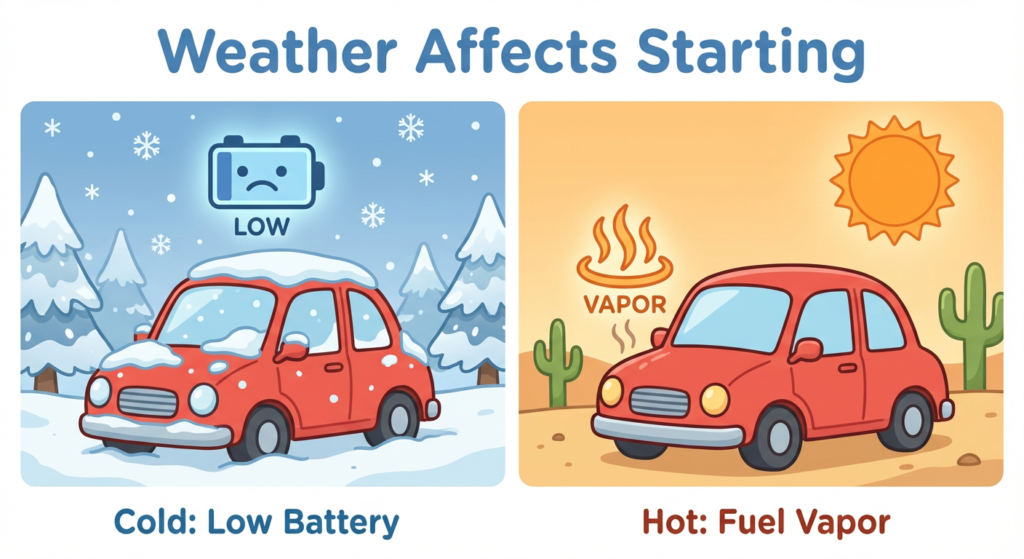
Reason #5 — Environmental or Temperature Effects
Sometimes, the environment plays a big role in how your car starts.
- What it is: Extremely cold weather can cause engine oil to thicken, making it harder for the engine to turn over. It also reduces the chemical efficiency of the battery, lowering its power output. Extreme heat can sometimes cause fuel to vaporize in the fuel lines, creating a “vapor lock” that makes starting difficult.
- What you might feel: The car is significantly harder to start on very cold mornings or after sitting in direct sun on a hot day.
What You Should Check First (Step-by-Step)
You can gather a lot of information without ever opening the toolbox. Perform these simple, safe checks:
- Listen Carefully: Pay attention to the sound. Is it a rapid clicking? A slow, sluggish crank? Or a normal-speed crank with no result? The sound is a major clue.
- Look at the Dashboard: When you turn the key, do the dashboard warning lights explained on your dash dim significantly or go out completely? This often points to a battery issue. Is the check engine light on?
- Check for Obvious Signs: Look at the battery terminals. Do you see any fuzzy, blue-green, or white corrosion? That can block the electrical connection.
- Try This Trick: Turn the key to the “On” position (without starting) and wait 3-4 seconds. You might hear a faint humming sound—that’s the fuel pump priming the system. Turn the key off, then on again. After doing this two or three times, try to start the engine. If it starts right up, it strongly suggests a fuel delivery issue.
- Note the Pattern: Does this only happen in the morning? Only when it’s cold? Or is it completely random? Keeping a mental log will be incredibly helpful if you need to talk to a mechanic. One of the best OBD2 scanners for beginners can also help you read any trouble codes.
When to Stop Trying and Get Help
While it’s usually okay to try starting the car a few times, you should stop and call for professional help if you notice any of these red flags:
- You smell a very strong odor of gasoline.
- You see or smell smoke coming from under the hood.
- The electrical systems (lights, radio) are completely dead.
- A loud grinding noise occurs when you turn the key.
- The engine fails to start after 5 or 6 repeated attempts.
Continuing to crank the engine can potentially damage the starter motor or other components.
Frequently Asked Questions
Why does my car struggle to start in the morning?
This is often due to a weak battery that loses charge overnight or because cold weather is making the engine oil thicker and the battery less effective.
Can a weak battery cause multiple cranking attempts?
Absolutely. A battery may have enough power to crank the engine slowly but not enough to do it fast enough for a quick start, leading to several tries.
Is it safe to keep trying to start the engine?
You can safely try a few times. However, if the car doesn’t start after 5-6 attempts, it’s best to stop. Excessive cranking can overheat and damage the starter motor and drain any remaining power from the battery.
Does temperature affect starting reliability?
Yes, both cold and hot weather can make starting more difficult. Cold reduces battery efficiency and thickens oil, while extreme heat can sometimes affect fuel delivery.
Final Thoughts
A car that takes a few tries to start is a puzzle, not a panic attack. You are now equipped with the knowledge to understand the clues your car is giving you. By calmly observing the sounds, sights, and patterns, you’ve taken the first and most important step toward a solution.
You don’t need to have the answer, but understanding the question is powerful. It builds your confidence and allows you to be an active partner in your car’s health, turning a moment of frustration into one of empowered understanding.