
Key Takeaways:
- Spark plugs act as the engine’s thermometer, revealing the health of your fuel system, oil seals, and internal combustion through their color and texture.
- While a visual “reading” tells you the history of what happened, an OBD2 scanner tells you what is happening in real-time, allowing you to catch misfires before they destroy your engine.
- Identifying the root cause—such as oil fouling—is critical; simply replacing the plug without fixing the leak will lead to an immediate recurrence of symptoms like car shaking while driving.
The “Spark Plug Story”: Why Diagnostics Matter
As a Master Diagnostic Technician, I often tell my clients that spark plugs are the “canaries in the coal mine.” Every time your engine completes a combustion cycle, the spark plug is at the center of the heat, pressure, and chemical reactions. Because of this, the tip of the plug becomes a permanent record of the environment inside that cylinder.
If you simply replace a worn plug without “reading” the old one, you are missing a vital diagnostic window. You might be ignoring a leaning fuel condition that will eventually melt a piston, or an oil leak that will soon cause the car to lose power while accelerating.
Quick Diagnostic Reference Table
| Look of the Plug | Meaning | Action Required |
| Light Tan / Gray | Healthy Combustion ✅ | Replace at standard service interval. |
| Dry, Black Soot | Carbon Fouled (Rich) ⚠️ | Check air filter, MAF sensor, or fuel injectors. |
| Wet, Oily Black | Oil Fouled 🚨 | Critical: Check valve guide seals or piston rings. |
| White / Blistered | Overheating (Lean) 🚨 | Check for vacuum leaks or incorrect heat range. |
| Crusty Brown | Ash Deposits ⚠️ | Switch fuel brands or check for oil additives. |
| Melted / Broken | Physical Damage 🚨 | Stop Driving: Heavy detonation or pre-ignition. |
Detailed Diagnostic Chart: Reading the “Look”
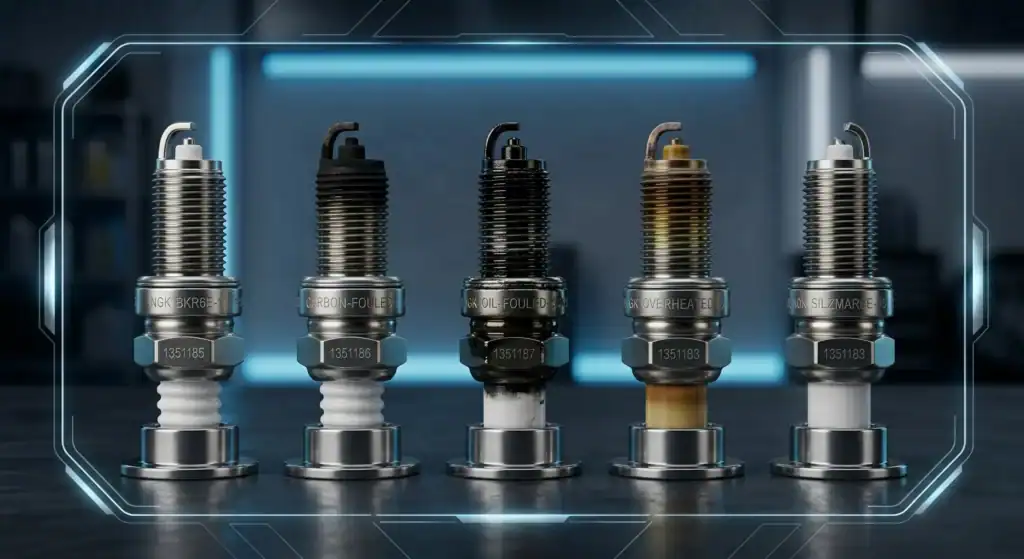
1. The Healthy Plug (Normal) ✅
Look: The porcelain insulator is a light tan or grayish-white color. There are minimal deposits, and the electrode is not rounded off.
- Engine Health: This indicates your air-fuel ratio is perfect, and your engine is not burning excess oil.
2. Carbon Fouled (The “Rich” Condition) ⚠️
Look: The entire tip is covered in dry, black, velvety soot.
- Symptoms: You may notice poor fuel economy or a car that starts then dies immediately.
- Causes: This is usually caused by an over-rich fuel mixture. Common culprits include a clogged air filter, a faulty Mass Air Flow (MAF) sensor, or frequent short trips where the engine never reaches operating temperature.
3. Oil Fouled (The Mechanical Warning) 🚨
Look: The plug is wet, oily, and black.
- Symptoms: Significant car shaking while driving and blue smoke from the exhaust.
- The “CarLogicLab” Warning: This indicates a mechanical engine problem, not just a plug problem. Oil is leaking past the piston rings or valve guide seals and into the combustion chamber. Replacing the plug is a “band-aid” fix; the root cause requires internal engine repair.
4. Overheated / Blistered (The “Lean” Condition) 🚨
Look: The insulator is stark white, often with a “peppered” look (tiny black specks) or a blistered surface.
- Symptoms: Pinging/knocking sounds during acceleration and a dangerous loss of power uphill.
- Causes: The engine is running too hot, often due to a lean air-fuel mixture (too much air), advanced ignition timing, or using a plug with an incorrect “heat range” for your car.
5. Ash Deposits ⚠️
Look: Light brown, crusty buildup on the electrodes or insulator.
- Causes: This is typically caused by poor fuel quality or certain oil additives. While not immediately fatal, it can mask the spark and lead to intermittent misfires.
The “Gap” Factor: Why It Triggers the Check Engine Light
The “gap” is the physical distance between the center and ground electrodes. Over time, the spark erodes the metal, and the gap becomes wider.
- The Strain: A wider gap requires higher voltage to jump. This puts immense strain on your ignition coils.
- The Trigger: When the coil can no longer provide enough voltage, you get a misfire. This is a primary cause of the Blinking Check Engine Light.
CarLogicLab Pro-Tip: Always label your plugs by cylinder number (e.g., #1, #2) as you remove them. If only one plug is oil-fouled, you know exactly which cylinder has a mechanical failure, saving you hours of diagnostic time.
DIY Action Plan: The Reading Workflow
To accurately diagnose your engine, follow this professional workflow:
- Pull the Plug: Use a spark plug socket and extension to remove the plugs one by one.
- Compare to Chart: Use the table above to identify the “Look.”
- Check OBD2 Codes: Even if you see the problem, plug in a scanner. A code like P0302 confirms the misfire is on Cylinder 2, matching your oil-fouled plug.
- Identify Root Cause: Use the information to decide if you need a new air filter ($20) or a head gasket ($1,500).
Strategic Recommendations
While “reading” a plug tells you what happened in the past, an OBD2 scanner tells you what is happening in real-time. We recommend the Top 5 Car Diagnostic Scanners for 2026 for any DIYer who wants to catch these issues before they lead to a total car won’t start situation.
If you find your plugs are worn but otherwise healthy, ensure you replace them with high-quality materials. Check our guide on [Iridium vs. Platinum] to find the right match for your engine’s requirements.
Internal Resources:
- Pillar Page: Bad Spark Plug Symptoms
- Support Guide: Check Engine Light On? 7 Causes, What It Means & What To Do.