
Key Takeaways:
- Always perform this repair on a stone-cold engine to prevent stripping the delicate aluminum threads in your cylinder head.
- Hand-threading is the “Golden Rule”—never use a wrench to start a plug into the cylinder.
- Using a dedicated torque wrench prevents the most common DIY disaster: cracked porcelain or a blown-out spark plug.
The CarLogicLab Philosophy: Precision Over Speed
Knowing how to change spark plugs is the ultimate “gateway” DIY project. It can save you over $200 in labor and immediately restore lost fuel economy. However, as an expert field mechanic, I have seen more engines ruined by a “quick 15-minute swap” than almost any other repair.
One cross-threaded hole or one cracked porcelain insulator can turn a $50 maintenance task into a $3,000 engine head replacement. At CarLogicLab, we focus on the Surgical Approach—doing it once, doing it right, and keeping your engine safe.
The Essential Tool Checklist
Before you pop the hood, you need the right kit. Using standard sockets or skipping the torque wrench is how simple jobs turn into nightmares.
- 5/8″ or 9/16″ Spark Plug Socket: Must have a rubber insert or magnetic core to hold the plug.
- 3/8″ Drive Click-Type Torque Wrench: Essential for accuracy on modern aluminum engines.
- Gap Gauge (Feeler Gauge): To verify that “pre-gapped” plugs weren’t damaged in shipping.
- 10mm Socket: Usually required to remove the ignition coil retaining bolts.
- Compressed Air: A can of air or a compressor to clear debris before opening the cylinder.
Shop the CarLogicLab Kit: *
- The Best Value: GearWrench Magnetic Swivel Spark Plug Socket
- The Pro Choice: Tekton 3/8″ Drive Torque Wrench
Safety First: The Cold Engine Rule
Never work on a hot engine. Metal expands when hot. If you attempt to remove a steel spark plug from a hot aluminum cylinder head, the threads are significantly more likely to gall or “pull” out with the plug. Additionally, the risk of severe burns from the exhaust manifold is high. Let the car sit for at least 3–4 hours before starting.
The “Surgical” Step-by-Step
Step 1: Prep and Debris Clearance
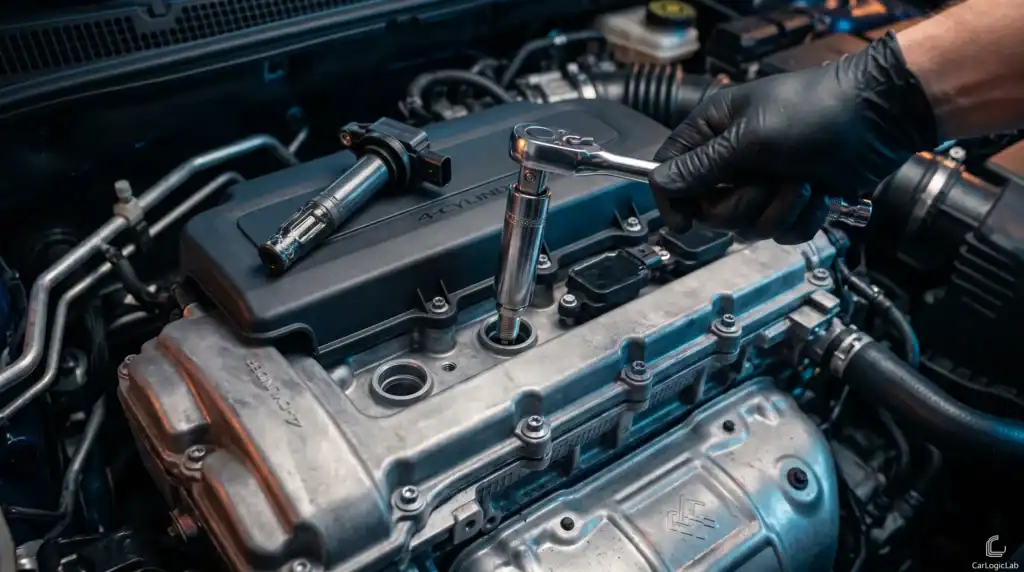
Pop the hood and remove the plastic engine cover. Before you touch a single bolt, use compressed air to blow out the area around the ignition coils.
- Why: Over years of driving, sand, pebbles, and dead bugs accumulate on top of the engine. If you pull the plug without cleaning first, that debris falls directly into your engine’s cylinders.
Step 2: Coil Removal
On most modern 4-cylinder engines, you will see four Ignition Coils sitting on top of the valve cover.
- Carefully depress the plastic tab on the electrical connector. Pro-Tip: If the plastic is brittle (common in older cars), use a small flathead screwdriver to gently lift the tab rather than squeezing it.
- Unbolt the 10mm retaining bolt.
- Pull the coil straight up. If it’s stuck, give it a slight twist to break the suction seal.
Step 3: Removing the Old Spark Plug
Place your spark plug socket and extension into the well. Ensure it is fully seated on the hex nut of the plug.
- Turn counter-clockwise to break the seal.
- If the plug feels unusually tight or “crunchy,” stop. Spray a tiny amount of penetrating oil into the well and let it sit for 10 minutes.
- Once the plug is out, stop! This is the perfect time for a how to read spark plugs diagnostic to see how your engine is really running.
CarLogicLab Pro-Tip: The Garden Hose Trick If your spark plugs are buried deep in the engine head, push a 6-inch piece of 3/8″ rubber vacuum or garden hose onto the tip of the new plug. Use the hose to lower and start the threads. If it cross-threads, the hose will simply slip on the plug instead of stripping your engine’s metal threads.
Step 4: Gapping the New Plugs
Even if your new [iridium vs platinum spark plugs] come “pre-gapped,” check them. They can be bumped in shipping. Look up your vehicle’s specific gap (e.g., 0.044 inches) and use your feeler gauge to verify.
- Warning: Be extremely careful with Iridium tips. Do not pry against the center electrode, or you will snap the precious metal tip.
Step 5: Hand-Threading (The “Golden” Rule)
Drop the new plug into the well and turn it by hand using only the extension bar—no wrench. You should be able to turn it 5–10 full rotations easily. If you feel resistance after one turn, back it out; you are cross-threading.
Step 6: Final Torquing
Once the plug is finger-tight, use your torque wrench to finish the job. Over-tightening can crack the head; under-tightening can cause the plug to “blow out.”
| Head Material | Plug Thread Size | Recommended Torque |
|---|---|---|
| Aluminum | 14mm | 15–20 lb-ft |
| Aluminum | 12mm | 10–15 lb-ft |
| Cast Iron | 14mm | 20–25 lb-ft |
The “Anti-Seize” Debate: To Use or Not?
At CarLogicLab, we follow the lead of major manufacturers like NGK and Denso.
- The Verdict: If the plug has a shiny silver finish (Trivalent plating), install it dry. This coating acts as a dry lubricant.
- The Risk: Adding wet anti-seize to these plugs reduces friction so much that your torque wrench will under-read, making it incredibly easy to over-torque and snap the plug shell.
Monetization: The “Bundle” Pitch
If your car has over 100,000 miles and you are seeing bad spark plug symptoms, your ignition coils have likely been overworking to jump the gap of your worn plugs.
The Smart Move: If you are already in there, it is the best time to check your ignition coils for cracks or “arc marks.” Replacing them now saves you from doing the labor twice. Check out our high-ticket recommendations for NGK Ignition Coil Sets on Amazon to restore your factory performance.
Finishing the Job: The Scanner Close
Once the new plugs and coils are installed, start the engine. It should idle smooth and quiet.
- Clear the History: Even if the car runs great, your ECU likely has stored P0300 misfire codes in its memory.
- Reset: Plug in your OBD2 Scanner and clear all codes. This allows the computer to start fresh and relearn the fuel trims with your new, efficient spark.
If you don’t have one yet, see our Best OBD2 Scanners of 2026 to find the tool that every DIYer needs in their glovebox.
Internal Resources:
- Diagnosis: Return to the Bad Spark Plug Symptoms if you’re still experiencing a rough idle.
- Material Science: Read our guide on Iridium vs Platinum Spark Plugs to understand why your new plugs are an upgrade.
- Troubleshooting: Still seeing a light? See Check Engine Light On? 7 Causes, What It Means & What To Do.