
Key Takeaways:
- Yes, worn, fouled or bad spark plugs are the #1 cause of the P0300 Random Misfire code because they age at the same rate, eventually failing together.
- A P0300 signals that the computer detects misfires across multiple cylinders, whereas P0301-P0304point to a single specific cylinder.
- Diagnosing a P0300 with an OBD2 scanner allows you to see “Freeze Frame” data—capturing exactly what the engine was doing when the failure occurred.
The Direct Answer: Why Your Dashboard is Panicking
If you’ve just scanned your car and seen a P0300 code, the short answer is yes—bad spark plugs are the most likely culprit. The P0300 code stands for “Random or Multiple Cylinder Misfire Detected.” Unlike codes P0301 through P0308, which point a finger at a specific cylinder, P0300 means the engine computer (ECU) is seeing the engine “stumble” but can’t pin the blame on just one spot. Since spark plugs are usually installed as a set, they tend to wear out at the exact same rate. When they reach their limit, they often start failing intermittently across the whole engine, triggering that frustrating random code.
Why Spark Plugs are the #1 Suspect: The Voltage Gap
As a Diagnostic Specialist, I always look at spark plugs first for a P0300. To understand why, you have to understand the “Voltage Requirement” increase.
Every spark plug has a physical gap between its electrodes. As you drive, the spark literally erodes the metal, making that gap wider over time.
- The Strain: A wider gap requires significantly more electrical voltage from your ignition coils to create a spark.
- The Failure: Eventually, the gap becomes so wide that the ignition system can no longer jump it consistently, especially under load (like driving uphill).
- The Result: The cylinder doesn’t fire, raw fuel enters the exhaust, and the ECU triggers a misfire code.
Related Pillar Guide: 7 Bad Spark Plug Symptoms
P0300 vs. P030X: Making the Distinction
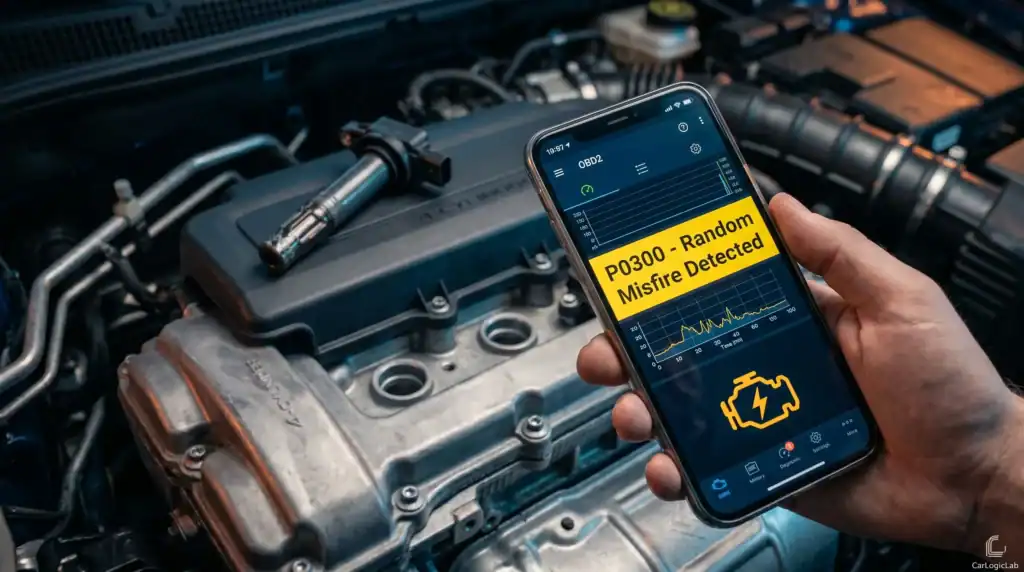
Understanding which codes accompany your P0300 is the secret to a fast fix.
Situation A: P0300 + A Specific Code (e.g., P0302)
If you see P0300 paired with P0302, the “Random” code is just a secondary alert. Your primary problem is Cylinder #2. This usually points to a single failed ignition coil or one specific fouled plug.
Situation B: P0300 ONLY
If the only code you have is P0300, the problem is likely affecting the entire engine. This is the hallmark of:
- Worn-out spark plugs (entire set).
- A vacuum leak affecting all cylinders.
- Low fuel pressure.
- A faulty Mass Air Flow (MAF) sensor.
How to Diagnose P0300 at Home (Step-by-Step)
Don’t start buying parts yet. Follow this CarLogicLab diagnostic workflow to save money.
Step 1: Scan for “Freeze Frame” Data
Using a high-quality scanner like those found on our Best OBD2 Scanners of 2026, look for “Freeze Frame” data. This is a snapshot of the engine’s health at the exact second the code triggered.
- The Clue: If the misfires happened at idle, look for a vacuum leak. If they happened at high RPM, look at your fuel pump or spark plugs.
Step 2: Visual Inspection
Pull a few plugs and compare them to a diagnostic chart.
- What to look for: Black soot (carbon fouling) or a white, blistered look (overheating). If the plugs look worn down or “rounded,” they are done.
- Detailed Guide: How to Read Spark Plugs
Step 3: The “Coil Swap” Trick (If a specific cylinder is mentioned)
If you also have a P0301 code, move the ignition coil from Cylinder #1 to Cylinder #2. Clear the codes and drive.
- If the code moves to P0302, the coil is bad.
- If the code stays at P0301, the spark plug or the fuel injector is the problem.
The CarLogicLab Fix Strategy: Scanners & Parts
When dealing with a P0300, the most logical first step in vehicle maintenance is a fresh set of plugs.
The “First Step” Tool
To monitor “Live Data” and see misfire counts in real-time, you need a reliable interface. We recommend the BlueDriver Bluetooth Professional OBDII Scan Tool. It pays for itself by allowing you to clear the code and verify the fix without a $120 trip to the mechanic.
The Parts Recommendation
For a P0300, don’t settle for cheap copper plugs. Modern ECUs are highly sensitive to electrical resistance. We recommend:
- NGK Laser Iridium: These provide the most stable spark and lowest voltage requirement for modern engines.
- Denso Iridium Power: Excellent for restoring performance in high-mileage vehicles.
The Financial “Safety Net”: Fix Now or Pay Later
| Symptom | Code | Fix Cost (DIY) | Neglect Cost |
| Mild Hesitation | P0300 | $100 (New Plugs) | $2,500 (Melted Catalytic Converter) |
| Blinking CEL | P0301-P0308 | $150 (Plug + Coil) | $5,000+ (Internal Engine Damage) |
Survival Tip: A blinking check engine light with a P0300 code means you are actively damaging your catalytic converter. Stop driving immediately.
Internal Resources & Next Steps
Ready to clear that code? Use these guides to finish the job:
- The Tutorial: How to Change Spark Plugs on a 4-Cylinder Engine
- The Performance Check: Iridium vs Platinum Spark Plugs: Which is Best?
- The Hub: Return to our Check Engine Light On? 7 Causes, What It Means & What To Do for a complete system overview.
Pro-Tip: If you replace the plugs and the P0300 returns, your next check should be for a vacuum leak or a dirty MAF sensor. Don’t keep driving with a misfire—your engine’s “brain” is trying to save your wallet!